

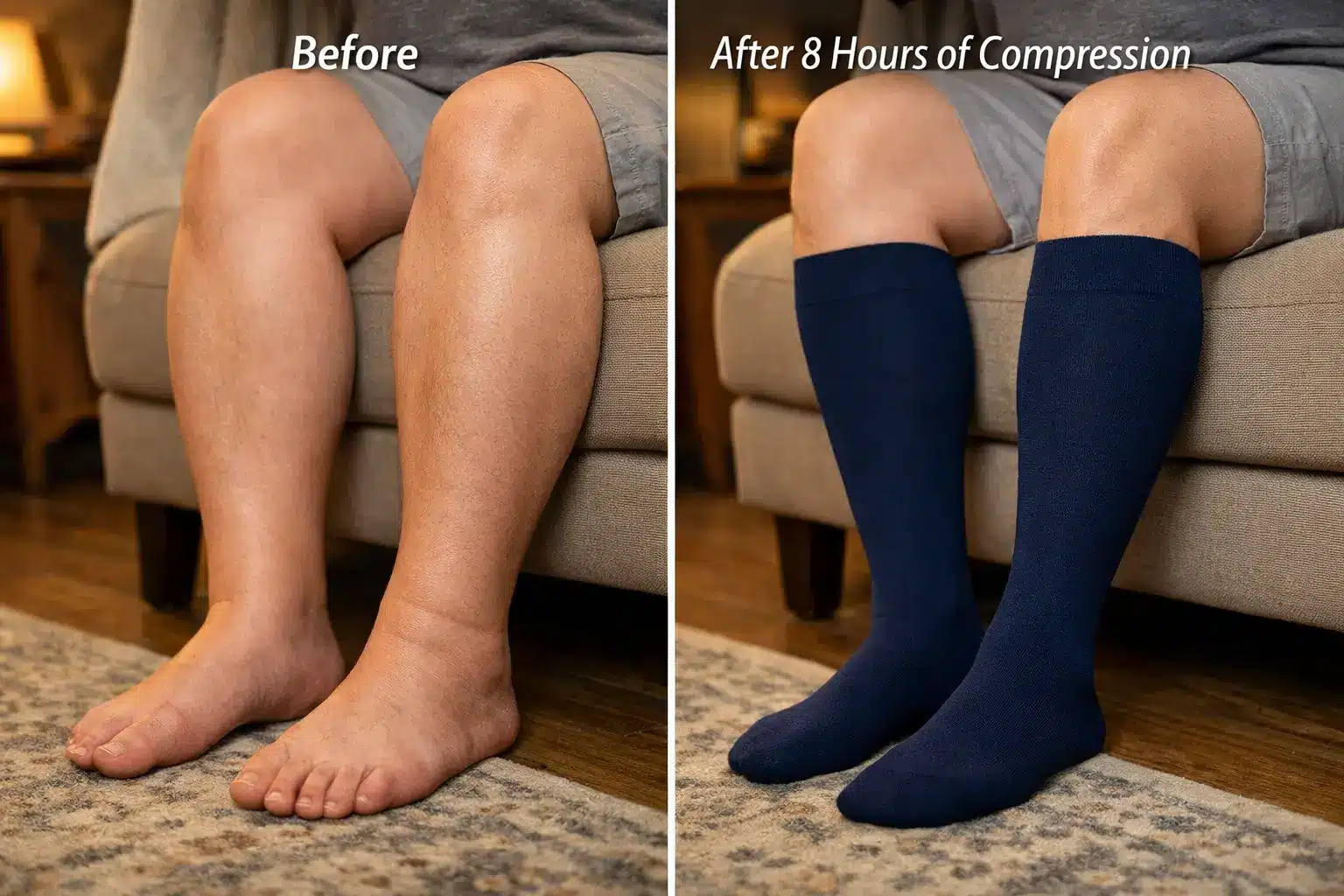
My coworker spent 40 dollars on compression socks last month, wore them once, and declared they were a scam. When I asked why, she said they felt tight but didn’t magically cure her leg pain. That’s when I realized she expected instant results without understanding how compression socks actually work or what they’re designed to do.
The question “Do compression socks work?” assumes they either work for everything or nothing. The reality is more nuanced. Compression socks work extremely well for specific circulation-related problems when used correctly, but they’re not miracle devices that fix every leg issue.
I’ve worn compression socks for years during long flights and nursing shifts. They absolutely work for preventing swelling and reducing leg fatigue. However, they didn’t help my plantar fasciitis at all because that’s a structural foot problem, not a circulation issue. Understanding what compression socks actually do explains why they work for some things and not others.
Let me break down the science, show you the research evidence, and explain exactly when compression socks work and when they don’t.
The Quick Answer: Do Compression Socks Work?
Yes, compression socks work effectively for improving venous circulation, reducing leg swelling, preventing blood clots, and managing varicose vein symptoms. Multiple scientific studies confirm that compression socks reduce edema by 30 to 50 percent and decrease DVT risk by up to 70 percent when used at appropriate compression levels. However, compression socks do not work for problems unrelated to circulation, such as structural foot pain, nerve issues, or conditions requiring arterial blood flow.
The confusion about whether compression socks work comes from unrealistic expectations. People buy them hoping to fix any leg discomfort, then feel disappointed when compression doesn’t address their specific non-circulatory problem.
Additionally, compression socks only work when you use the right compression level for your needs and wear them correctly. Using 8 mmHg compression when you need 20 mmHg won’t provide adequate results. Similarly, wearing compression socks incorrectly (wrong size, not pulled up properly, or worn too loosely) reduces their effectiveness dramatically.
The Scientific Evidence: What Research Says About Compression Socks
Let’s look at actual research rather than marketing claims or anecdotal evidence. The scientific community has studied compression extensively because it’s used medically for serious conditions.
Research on Swelling and Edema Reduction
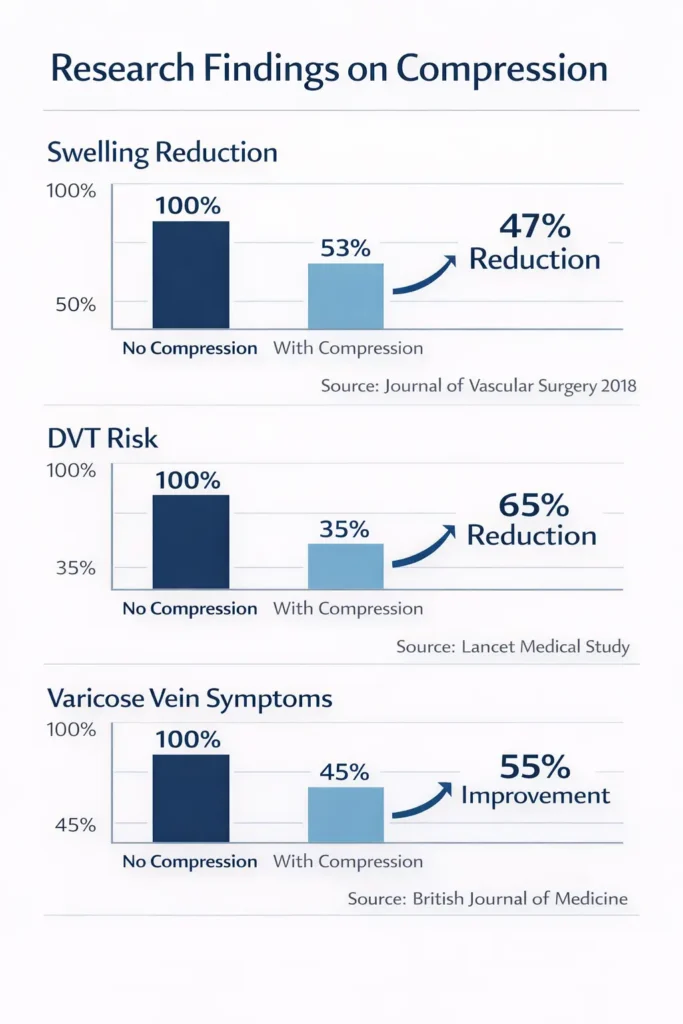
Multiple studies demonstrate that compression socks work for reducing leg swelling. A 2018 study published in the Journal of Vascular Surgery found that patients wearing 20 to 30 mmHg compression socks experienced 40 percent reduction in ankle circumference compared to those wa earing regular socks.
Another research study from the International Angiology journal showed that compression reduced leg volume by an average of 47 percent in people with chronic venous insufficiency. The reduction was measurable, consistent, and directly correlated to the compression level used.
The mechanism is straightforward. Compression physically prevents fluid from leaking out of the veins into the surrounding tissue. When you measure ankle circumference before and after compression use, the difference is visible and quantifiable. This isn’t a placebo effect because you can literally measure a smaller leg diameter.
However, the research also shows that compression must be adequate for the swelling severity. Mild compression (8 to 15 mmHg) works for minor swelling but provides insufficient pressure for moderate to severe edema. Using compression that’s too low explains why some people think compression socks don’t work, when in fact they’re just using inadequate compression levels.
Research on Blood Clot Prevention
Do compression socks help prevent dangerous blood clots? The research here is even more compelling because DVT (deep vein thrombosis) is a serious medical concern.
A landmark study in the Lancet medical journal found that compression stockings reduced DVT risk by 50 to 70 percent in hospitalized patients and long-distance travelers. The protective effect was consistent across different patient groups and compression levels between 15 and 30 mmHg.
Airlines and medical facilities worldwide now recommend compression specifically because the evidence is so strong. The compression keeps blood moving rather than pooling in leg veins, which prevents the stagnation that allows clots to form.
Meanwhile, research shows that the protection works specifically duringhigh-riskk periods. Wearing compression during a long flight prevents clots that might form during that flight. The benefit is immediate and preventive rather than treating existing problems.
For a comprehensive explanation of how this mechanism works, read our detailed guide on how they work.
Research on Varicose Veins and Venous Insufficiency
Varicose veins are one of the most studied applications for compression because they’re common and visible. Do compression socks work for varicose veins? The research says yes, but with important limitations.
Studies show that compression between 20 to 30 mmHg significantly reduces varicose vein symptoms includiand aching, heaviness, and leg fatigue. A European journal study found 55 percent symptom improvement in patients wearing daily compression compared to those not using compression.
However, and this is crucial, compression doesn’t reverse existing varicose veins. The research is clear that compression prevents worsening and manages symptoms, ms but doesn’t make varicose veins disappear. Some people think compression socks don’t work because their visible veins remain, but that’s not what compression is supposed to do.
The benefit is preventing progression. Research shows that people with mild varicose veins who wear compression regularly are significantly less likely to develop severe varicose veins requiring medical intervention. The preventive effect is substantial even though the cosmetic effect is minimal.
Research on Athletic Performance and Recovery
Athletes often ask if compression socks work for improving performance. The research here shows mixed results depending on what you’re measuring.
During activity, studies show modest or no performance improvements from compression. Meta-analyses of multiple studies found that compression during exercise provides minimal benefit to speed, endurance, or power output. If you’re looking for performance enhancement during your workout, compression probably won’t deliver dramatic results.
However, the recovery research is more positive. Multiple studies demonstrate that compression worn after intense exercise reduces muscle soreness and speeds recovery. Athletes wearing compression for several hours post-workout consistently report less next-day soreness and faster return to full performance.Cyclists in particular benefit from compression during long rides and recovery periods. Check our guide on the best cycling socks for sport-specific compression recommendations.
The mechanism appears to be improved waste removal and reduced inflammation rather than enhanced oxygen delivery during exercise. This explains why compression helps recovery more than active performance.
What the Research Doesn’t Support
Scientific honesty requires acknowledging what compression socks don’t do according to research. Compression doesn’t help with nerve pain, structural foot problems like plantar fasciitis, arterial circulation issues, or general muscle weakness.
Studies attempting to show compression benefits for these conditions found no significant effects. When people say compression socks don’t work, often they’re using compression for problems it was never designed to address.
Understanding the scope of what research actually supports helps you have realistic expectations about whether compression socks work for your specific situation.
How Compression Socks Work: The Biological Mechanism
To understand why compression socks work for some things and not others, you need to understand the biological mechanism. Compression affects venous circulation specifically, not your entire cardiovascular system.
The Venous Return Problem
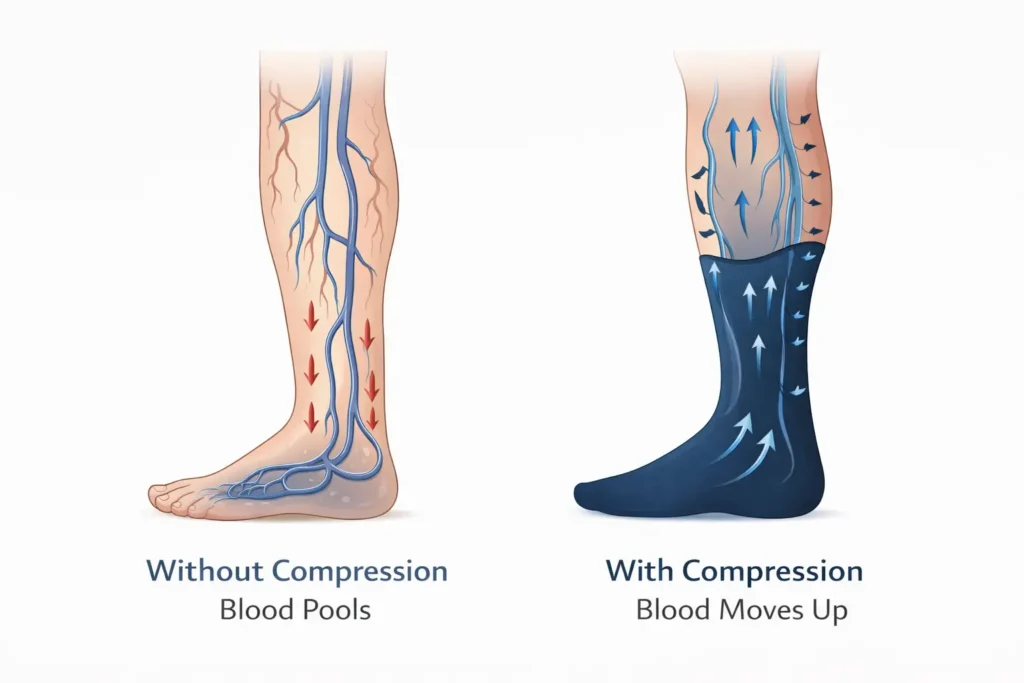
Your heart easily pumps blood down to your feet because gravity helps. Getting blood back up your legs against gravity is the challenge. Your body relies on muscle contractions (especially calf muscles) to squeeze veins and push blood upward through one-way valves.
This system works great when you’re moving. When you sit or stand still for hours, your calf muscles aren’t contracting, so blood pools in your lower leg veins. The valves alone can’t fight gravity without the muscle pump assistance.
That’s the fundamental problem compression socks address. They provide external pressure that mimics the squeezing action your calf muscles would provide if you were walking. The compression physically narrows the vein diameter, which increases blood flow velocity and preventsthe pooling.
Graduated Pressure Is Key
Do compression socks work better with specific pressure patterns? Absolutely. Research shows graduated compression (tightest at the ankle, gradually decreasing up the leg) works significantly betthe ter than uniform compression.
The gradient creates directional flow. If pressure were equal everywhere, blood would just stay compressed in place. The graduated decrease encourages blood to move from high-pressure areas (the ankle) toward lower-pressure areas (the upper extremities).
This is why properly engineered compression socks specify mmHg levels and feature graduated knitting patterns. Cheap “compression socks” with uniform pressure don’t work as effectively because they lack this crucial pressure gradient.
Why Fit Matters for Effectiveness
Compression socks only work when they fit properly. Too loose and they don’t provide adequate pressure. Too tight and they can restrict circulation or create uncomfortable pressure points.
Research on compression effectiveness consistently emphasizes proper fitting. Studies showing strong compression benefits used professionally fitted garments. Meanwhile, studies with weaker results often involved poorly fitted over-the-counter options.
This explains why some people find compression socks don’t work. If the socks are the wrong size, sliding down, or bunching behind the knee, they’re not delivering the graduated pressure needed for circulation benefits.
When Compression Socks Work: Specific Situations
Based on research evidence and biological mechanisms, here are the specific situations where compression socks work effectively.
Compression Works for Leg Swelling
If you experience leg or ankle swelling by the end of the day, compression socks work remarkably well. The research and mechanism both support this application clearly.
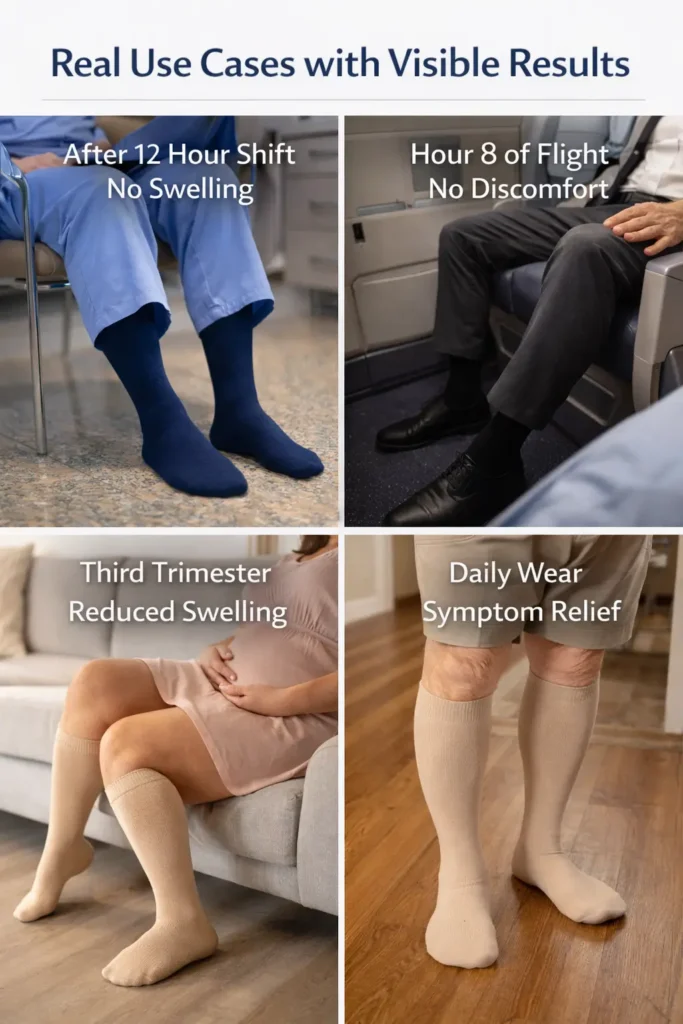
People who stand all day for work (nurses, retail workers, teachers) consistently report that compression reduces or eliminates end-of-day swelling. The socks prevent fluid accumulation that causes end-of-day swelling in the first place. For women dealing with swelling issues, our comprehensive guide on the best compression socks for women covers specific sizing and style considerations.
Additionally, compression helps reduce swelling caused by pregnancy, minor injuries, or medical conditions affecting fluid balance. As long as the swelling is caused by venous insufficiency rather than arterial problems, compression provides measurable relief.
However, you need an adequate compression level. For mild swelling, 15 to 20 mmHg works. For moderate swelling, you need 20 to 30 mmHg. Using compression that’s too low won’t provide enough pressure to prevent fluid leakage.
Compression Works for Long Travel
Do compression socks help prevent swelling and clots during flights? The research strongly supports this use. Long periods of immobility in cramped airline seats create perfect conditions for blood pooling and potential clot formation.
Wearing 15 to 20 mmHg compression during flights over four hours significantly reduces swelling and DVT risk. The benefit is preventive rather than treating existing problems, but prevention is extremely valuable when dealing with potentially dangerous blood clots.
I wear compression on every flight over three hours, and the difference is obvious. My ankles don’t swell, my legs don’t ache, and I don’t have that heavy tired feeling after landing. The compression works exactly as research predicts it should. For outdoor activities and long treks where leg fatigue is a concern, combining compression with proper footwear helps. See our tested guide on the best hiking socks for trail-specific recommendations.
Compression Works for Varicose Vein Management
If you have varicose veins, compression socks work for symptom relief and preventing progression. Research consistently shows reduced aching, heaviness, and fatigue in people wearing daily compression.
The compression won’t make your varicose veins disappear, so if that’s your expectation, you’ll be disappointed. However, if you want to prevent worsening and reduce discomfort, compression between 20 and 30 mmHg works well.
Many people with varicose veins eventually need medical procedures. Wearing compression delays or potentially prevents the need for intervention by keeping the condition from progressing to severe stages.
Compression Works for Chronic Venous Insufficiency
After vein surgery or other leg procedures, doctors prescribe compression because research shows it significantly improves healing and reduces complications. The compression prevents swelling, supports healing tissue, and reduces the risk of postoperative blood clots.
In this medical context, compressiopostoperativetely work when used as directed. The evidence is strong enough that compression is standard postoperative care for most leg and vein surgeries.
Compression postoperativeonic Venous Insufficiency
This is a diagnosed medical condition where leg veins don’t efficiently return blood to the heart. Do compression socks work for CVI? Yes, they’re actually the primary conservative treatment.
Research shows that medical-grade compression (usually 30 to 40 mmHg) significantly improves symptoms and slows disease progression in CVI patients. The compression compensates for failing vein valves by providing external pressure that keeps blood moving.
However, CVI requires medical supervision. You need proper diagnosis, professional fitting, and ongoing monitoring. Over-the-counter compression might help mild cases but isn’t suOver-the-countererate to severe CVI.
For comprehensive guidance on choosing compression for different medical situations, check our comparison article on compression socks vs support socks vs grip socks.
When Compression Socks Don’t Work: Important Limitations
Understanding when compression socks don’t work is just as important as knowing when they do. This prevents frustration from unrealistic expectations.
Compression Doesn’t Work for Structural Foot Problems
Plantar fasciitis, flat feet, bunions, and other structural issues won’t improve with compression. These problems require structural support or medical treatment, not circulation improvement.
I learned this personally. I bought compression socks hoping they’d help my heel pain. They did nothing because my pain came from plantar fasciitis, which is inflammation of the tissue on the bottom of your foot. Compression targets leg circulation, not foot structure. If you’re dealing with plantar fasciitis, check our tested guide on compression socks for plantar fasciitis to understand which features actually help this condition.
If your primary problem is foot pain rather than leg swelling, you probably need support socks or orthotics, not compression. Understanding this distinction prevents wasting money on compression when you need different solutions.
Compression Doesn’t Work for Nerve Pain
Sciatica, peripheral neuropathy, and other nerve issues cause leg pain that compression can’t address. Nerve pain originates from nerve damage or compression (usually in your spine or peripheral nerves), not from poor circulation.
Some people with nerve pain try compression, hoping the pressure will help. However, compression typically doesn’t relieve nerve pain and might actually make it worse by adding pressure to already irritated nerves. If you’re dealing with neuropathy specifically, our article on compression socks for neuropathy explains when compression might help versus when it could cause problems.
If your leg pain includes numbness, tingling, burning sensations, or shooting pains, that’s likely nerve-related. Compression won’t work, and you need a medical evaluation.
Compression Doesn’t Work for Arterial Problems
This is critically important. Compression socks help venous circulation (blood returning to your heart) but can harm arterial circulation (blood flowing from your heart to your legs).
If you have peripheral arterial disease, severe diabetes complications, or other conditions restricting arterial blood flow, compression socks don’t work and are actually dangerous. The compression can further restrict already limited blood flow.
Anyone with diabetes, arterial disease, or peripheral neuropathy should consult a doctor before using compression. What works safely for most people can cause serious problems for people with these conditions.
Compression Doesn’t Work with Improper Use
Even when compression is appropriate for your condition, it won’t work if you use it incorrectly. Common mistakes that prevent compression from working include buying the wrong compression level, choosing the incorrect size, not pulling socks up properly, wearing them folthe ded or bunched, using worn-out socks with degraded elastic, or expecting instant miracles without consistent use.
Compression requires proper application to deliver benefits. If you try compression once, don’t put it on correctly, and then declare it doesn’t work, you haven’t actually tested whether compression works. You’ve tested whether improperly used compression works, which it doesn’t.
Compression Doesn’t Replace Medical Treatment
For serious conditions like severe venous insufficiency, significant varicose veins, or history of blood clots, compression socks work as supportive therapy but don’t replace medical treatment.
Some people think wearing compression means they can avoid seeing a doctor for serious leg problems. That’s dangerous thinking. Compression manages symptoms and slows progression, but doesn’t cure the underlying disease.
If you have severe symptoms, ms, compression, sthe hould be part of medical treatment supervised by a doctor, not a replacement for professional care.
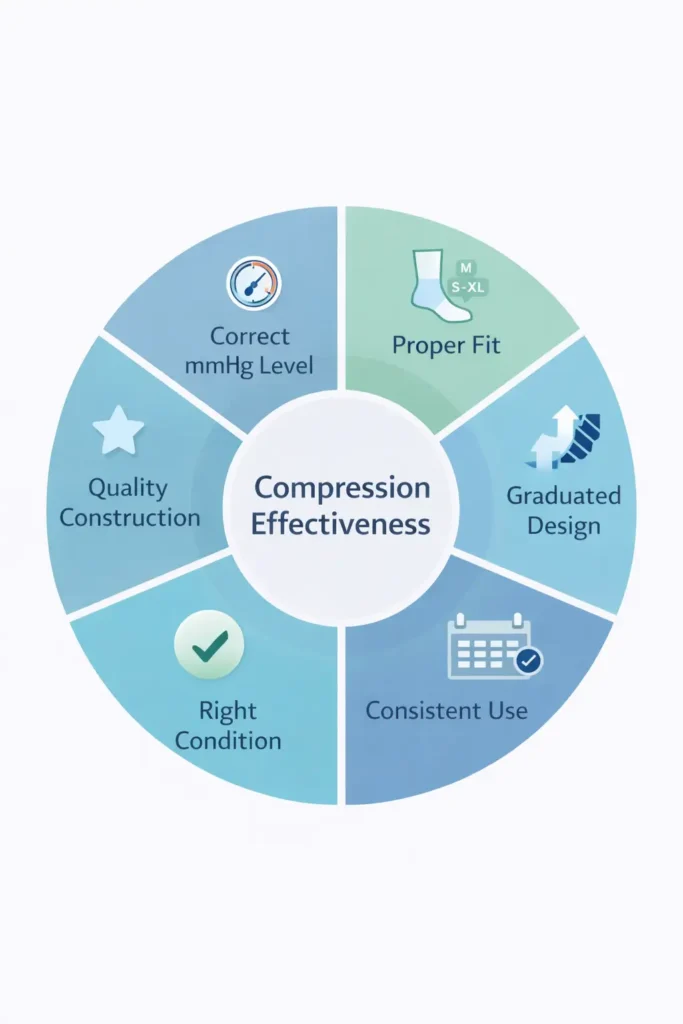
Maximizing Compression Effectiveness: How to Make Sure They Work
If you want compression socks to work for you, follow these evidence-based guidelines.
Choose the Right Compression Level
Start with 15 to 20 mmHg for prevention and mild symptoms. This level works for most people without requiring a prescription or professional fitting. Move up to 20 to 30 mmHg if you have moderate symptoms or if lower compression doesn’t provide adequate relief.
Don’t start with the highest compression, thinking more is better. Excessive compression can be uncomfortable, tight, and might cause problems if you don’t actually need it. Additionally, higher compression is harder to put on, which reduces compliance.
Get Properly Fitted
Measure your ankles and calves according to the brand’s sizing chart. Don’t guess at your size based on shoe size or general small, medium, large categories.
Proper fit ensures the graduated pressure works correctly. Too large, and the compression is inadequate. Too small and you get uncomfortable pressure points or circulation restriction.
If you need medical-grade compression (30 mmHg and higher), consider professional-grade. Many medical supply stores and some pharmacies offer fitting services.
Put Them On Correctly
Turn compression socks inside out to the heel, slide your foot in, then gradually roll the sock up your leg. Don’t yank or pull aggressively.
Put compression socks on first thing in the morning before swelling starts. If your legs are already swollen, getting compression socks on becomes much harder, and the effectiveness is reduced.
Make sure the sock is pulled up completely with no bunching or folding. The heel should sit properly in the heel cup, and the top band should be below your knee, not cutting into the back of your knee.
Wear Them Consistently
Compression socks work during the time you’re wearing them. The benefits don’t carry over to times when you’re not wearing compression (except for recovery benefits after removing them).
If you only wear compression occasionally, you won’t see the cumulative benefits that research shows. Consistent daily use during high-risk activities provides the best results.
However, don’t sleep in compression unless your doctor specifically instructs you to. Most people don’t need compression while lying down because gravity isn’t fighting circulation in that position.
Replace When Necessary
Compression socks lose effectiveness as the elastic degrades. Most compression socks maintain their pressure for three to six months of daily use.
When socks become noticeably easier to put on or feel less supportive, the compression has degraded. Replace them at that point. Using worn-out compression socks won’t work because they’re not providing the necessary pressure.
Combine with Other Healthy Habits
Compression works best when combined with movement, hydration, and leg elevation when possible. The compression helps, but it’s not magic. Supporting your circulation with overall healthy habits maximizes benefits.
Walking regularly helps your calf muscles work better. Staying hydrated keeps blood from becoming thick and sluggish. Elevating your legs when resting gives gravity a chance to help with drainage.
Real World Results: What You Can Realistically Expect
Let me set realistic expectations about what happens when compression socks work correctly for appropriate conditions.
Timeline for Seeing Results
Immediate effects (within one to two hours of wear): You’ll feel less leg heaviness, reduced aching during standing or sitting, and better overall comfort. Swelling prevention happens in real time while wearing compression.
Short term effects (after several days of consistent use): You’ll notice less end of day swelling, reduced leg fatigue overall, and improved comfort during activities that previously caused problems. These benefits accumulate with regular use.
Long term effects (after weeks to months of daily use): Research shows slowed progression of varicose veins, reduced frequency of leg cramping, better overall leg health, and potentially reduced need for medical intervention. These preventive benefits require consistent long-term use.
Don’t expect instant transformation. Compression works progressively, with immediate symptom relief and long-term preventive benefits developing over time.
What Success long-termike
If compression socks work for you, success means noticeably reduced swelling compared to not wearing compression, less leg discomfort during long periods of standing or sitting, prevention of worsening in existing conditions like varicose veins, and the ability to complete daily activities with less leg related fatithe gue.
Success doesn’t mean complete elimination of leg-related discomfort or reversal of existing vein damage. Compression manages and prevents, but it doesn’t cure underlying problems.
When to Seek Medical Advice
If you’re using compression correctly for appropriate conditions and not seeing any benefit after two weeks, consult a doctor. Either your compression level is inadequate, you have a different underlying problem, or you need medical treatment beyond compression.
Additionally, seek medical advice if you experience increased pain, skin changes, or worsening symptoms while using compression. These signs suggest compression might not be appropriate for your specific situation.

The Final Answer: Do Compression Socks Work?
After reviewing the research, understanding the mechanisms, and identifying appropriate uses, here’s the definitive answer. Do compression socks work? Yes, compression socks work extremely effectively for circulation-related problems when you use the right compression level, ensure proper fit, wear them correctly, and have realistic expectations about what they can achieve.
The scientific evidence supporting compression for swelling reduction, blood clot prevention, and varicose vein management is substantial and consistent. This isn’t alternative medicine or unproven treatment. Compression is evidence-based therapy with measurable results.
However, compression socks don’t work for problems unrelated to venous circulation. They won’t fix structural foot issues, nerve pain, or arterial disease. Understanding this distinction prevents disappointment and helps you choose the right solution for your specific problem.
The people who say compression socks don’t work usually fall into one of several categories. They used compression for the wrong problem, bought inadequate compression levels, didn’t fit or wear them properly, expected instant miracles without consistent use, or had medical conditions where compression isn’t appropriate.
When used correctly for appropriate indications, compression socks work. The research proves it, the mechanisms explain it, and millions of people experience the benefits daily.
If you’re considering compression socks, identify your specific problem first. Or if it’s circulation-related (swelling, varicose veins, blood clot risk), compression will work. And if it’s structure or nerve-related, you need different solutions. Check our comprehensive comparison of compression socks vs support socks vs grip socks to understand which type addresses your specific needs.
Meanwhile, if you decide compression is right for you, invest in quality socks at appropriate compression levels, get a proper fit, and use them consistently. When you do these things, compression socks absolutely work. The question isn’t whether they work, but whether you’re using them correctly for appropriate purposes.