


I stood in the sock aisle at Target, staring at packages labeled Small, Medium, and Large, completely confused. My shoe size is 9.5, which, according to one brand, means Medium, but another brand’s chart said Large. I grabbed both sizes, took them home, and discovered the Medium cut off my circulation while the Large bunched under my arches. Neither pair worked. I wasted sixteen dollars learning that sock sizing isn’t as simple as grabbing your shoe size equivalent.
That frustrating experience five years ago sent me down a rabbit hole of sock sizing research. I learned that sock sizes vary dramatically between brands, that different sock types require different fits, and that most people wear the wrong sock size without realizing it. The wrong size causes blisters, circulation problems, bunching, slipping, and premature sock wear. Meanwhile, properly sized socks feel invisible on your feet, perform their intended function perfectly, and last significantly longer.
After testing dozens of sock brands across every category, measuring hundreds of feet, and consulting with podiatrists and sock manufacturers, I’ve compiled everything you need to know about finding your perfect sock size. Whether you’re buying grip socks, compression socks, athletic socks, or dress socks, understanding sizing fundamentals ensures you get the fit that works for your feet.
The Quick Answer: How to Find Your Sock Size
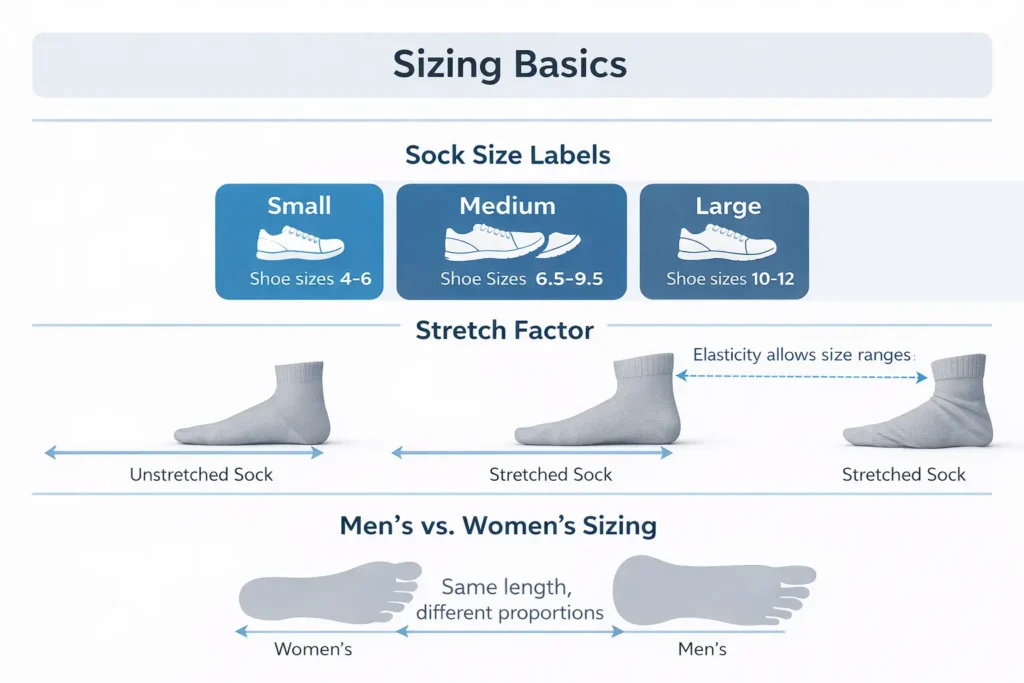
Your sock size corresponds primarily to your shoe size, but proper fit varies based on sock type and intended use. For standard socks, choose Small for women’s shoe sizes 4 to 6 (men’s 3 to 5), Medium for women’s 6.5 to 9.5 (men’s 5.5 to 8.5), and Large for women’s 10 to 12 (men’s 9 to 11). Extra Large fits women’s 12.5+ (men’s 11.5+). However, compression socks require precise measurements of calf circumference and ankle circumference beyond shoe size. Athletic socks often run smaller and need sizing up. Grip socks should fit snugly without restricting movement. Always check brand-specific sizing charts because sock sizes lack universal standardization across manufacturers.
The fundamental challenge with sock sizing is that, unlike shoes, socks must stretch to fit. This elasticity means sizing charts provide ranges rather than exact matches. Additionally, different sock constructions (compression, cushioned, thin dress socks) require different fits to function properly. Understanding these nuances prevents the common mistakes that lead to uncomfortable, poorly performing socks.
Understanding Sock Sizing Basics
Before diving into specific measurements and charts, let’s establish the fundamental principles that govern how sock sizes work and why they differ from shoe sizing.
Why Sock Sizes Aren’t Universal
Unlike shoe sizing, which follows relatively consistent standards (though still imperfect), sock sizing lacks universal regulation. Each manufacturer determines their own Small, Medium, Large definitions. One brand’s Medium might accommodate shoe sizes 6 to 9, while another brand’s Medium fits 7 to 10. This inconsistency stems from different manufacturing standards, target demographics, and sock construction methods.
European brands typically use numbered sizing (35-38, 39-42, etc.) that corresponds to shoe sizes, while American brands favor the Small/Medium/Large system. UK sizing follows yet another convention. This creates confusion when shopping internationally or comparing brands from different regions.
Additionally, sock materials affect sizing. Socks with high elastane or spandex content stretch more, allowing broader size ranges. Natural fiber socks, like pure cotton or wool, have less stretch and require more precise sizing. The percentage of elastic fibers directly impacts how forgiving the fit will be.
The Relationship Between Shoe Size and Sock Size
Sock sizes correlate with shoe sizes because foot length remains the primary determinant of fit. However, this relationship isn’t perfectly linear. Shoe sizes account for length, width, and volume, while sock sizes primarily consider length with some accommodation for width through stretch.
Most sock sizing charts use shoe size as the starting point. You find your shoe size on the chart, and it indicates the corresponding sock size. This works reasonably well for standard socks, but becomes problematic with specialized socks that require additional measurements beyond foot length.
For instance, compression socks need calf and ankle measurements regardless of shoe size because compression depends on circumference, not length. Similarly, grip socks for athletics require snug fit that may differ from your typical sock size to prevent slipping during movement.
Men’s vs Women’s Sock Sizing
Men’s and women’s sock sizes differ not just in the size ranges they cover,r but in the proportions they accommodate. Women’s feet are typically narrower relative to length compared to men’s feet. Women’s socks account for this with slightly narrower heel cups and toe box, es even when the length matches men’s sizing.
However, these gender distinctions are becoming less rigid. Many brands now offer unisex sizing, particularly in athletic and performance socks. Unisex sizing works well for people whose feet don’t match typical gender proportions, such as women with wider feet or men with narrower feet.
When shopping, focus on the actual measurements and size ranges rather than gender labels. If you’re a woman with wide feet and a men’s Medium fits better than a women’s Large, the men’s sock is the right choice, regardless of marketing claims.
How to Measure Your Feet for Socks
Accurate foot measurements eliminate sizing guesswork and ensure proper fit, particularly for specialized socks that require precision. Here’s how to measure correctly.
Measuring Foot Length
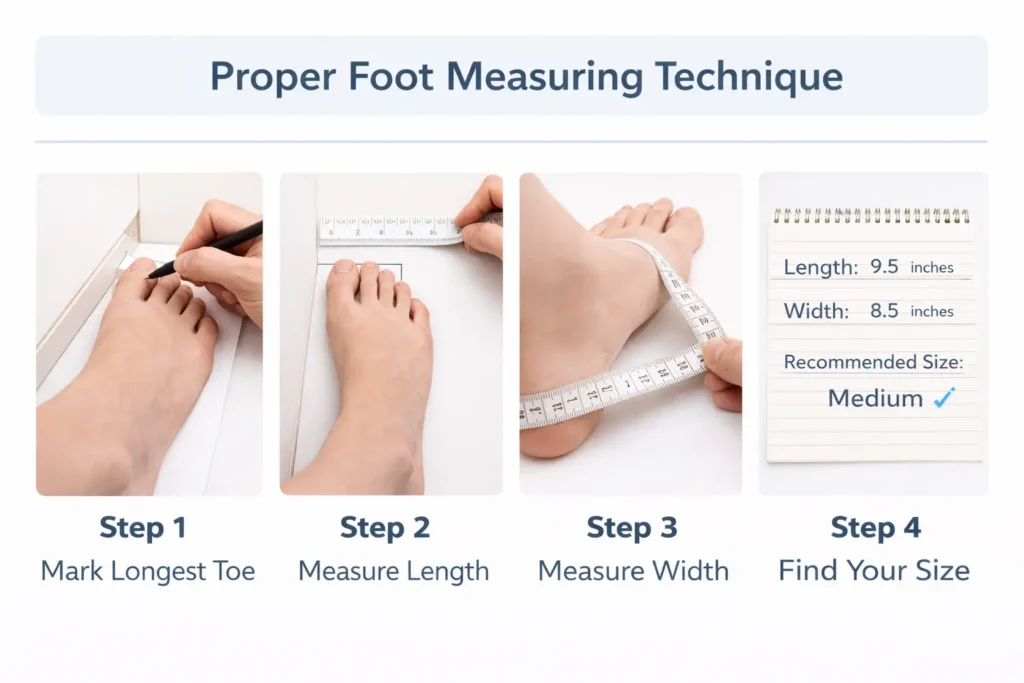
Foot length is the primary measurement for sock sizing. To measure accurately, you’ll need a ruler or measuring tape, a piece of paper, and a pen. Stand barefoot on the paper with your heel against a wall. Mark the longest point of your foot (usually your big toe or second toe). Measure from the wall to the mark in inches or centimeters.
Measure both feet because most people have slight size differences. Use the measurement from your larger foot for sock sizing. Take measurements in the evening when feet are slightly swollen from daily activity. This represents your foot at its largest, ensuring socks won’t feel tight during normal wear.
For the most accurate reading, have someone else do the measuring while you stand with the weight evenly distributed. When you bend to measure yourself, your weight shifts and can slightly alter foot length. The difference is small, but it matters for precision fits like compression socks.
Measuring Foot Width and Circumference
While less critical for standard socks, foot width and circumference matter for specialized socks. Measure the widest part of your foot (ball of foot) by wrapping a flexible measuring tape around it. Note this measurement in inches or centimeters.
For socks requiring arch support or compression, measure your arch circumference at the narrowest part of your ankle and at the widest part of your calf. These measurements are essential for compression sock sizing, which depends on precise circumference to provide correct pressure levels.
Additionally, measure from your heel to the bend of your knee if buying knee-high socks. This ensures adequate length without excess fabric bunching behind the knee or socks that don’t reach high enough.
Measuring for Different Sock Types
Different sock categories require different measurement priorities. Standard crew or ankle socks need only foot length. Compression socks require foot length, ankle circumference, calf circumference, and sometimes thigh circumference for thigh-high styles.
Grip socks for athletics benefit froma snug fit, so if you’re between sizes, size down for better grip performance. No-show socks need precise heel-to-toe length to sit correctly on your foot without showing above shoes or slipping down.
Diabetic socks prioritize comfortable fit without constriction, so measurements should account for any foot swelling. Measure feet when they’re at their most swollen to ensure diabetic socks accommodate fluctuations throughout the day.
For comprehensive guidance on specialized sock types, check our detailed guide on the best compression socks.
Converting Measurements to Sock Sizes
Once you have measurements, compare them to brand-specific sizing charts. Most charts show foot length in both inches and centimeters alongside corresponding sock sizes. For example, a foot measuring 9.5 inches (24 cm) typically fits Medium in most brands.
However, if your measurements fall at the boundary between two sizes (like 9.5 inches sitting between Medium 8-10 and Large 10-12), consider the sock type. Size up for dress socks or socks you’ll wear with thick insoles. Size down for athletic or grip socks where a snug fit improves performance.
Keep your measurements recorded in your phone or wallet. Having precise measurements available when shopping makes size selection quick and confident, whether buying in stores or online.
Sock Size Conversions (US, UK, EU)
International sock sizing differs significantly between regions. Understanding conversions helps when shopping from international brands or traveling abroad.
US Sock Sizing Standard
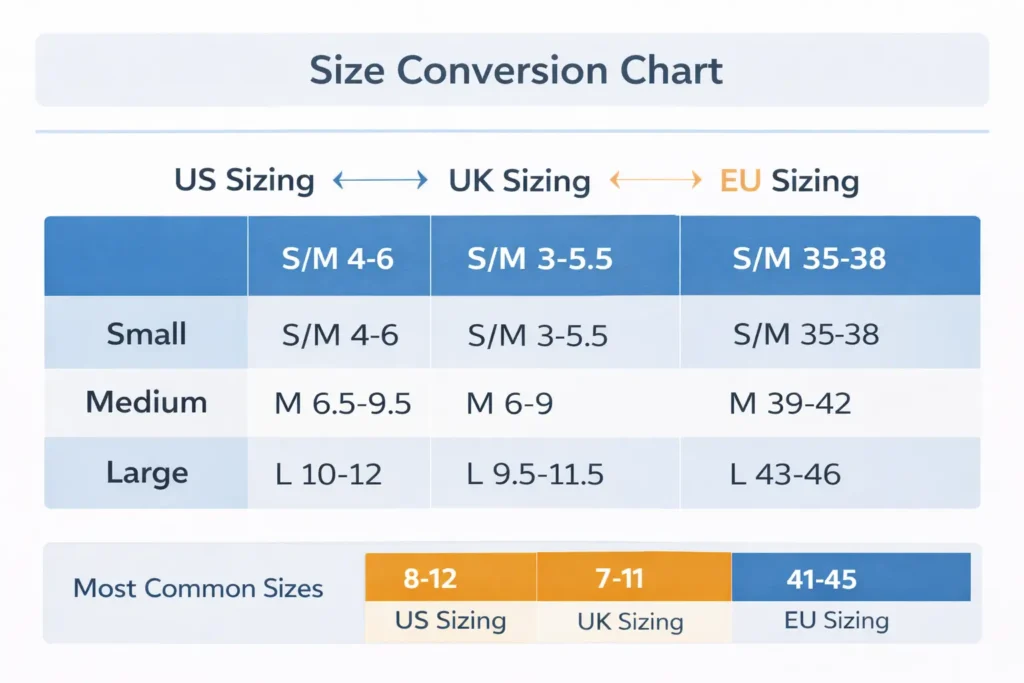
American sock sizing uses the Small, Medium, Large, Extra Large system based on shoe sizes. The typical breakdown follows this pattern, though individual brands vary:
Women’s US Sock Sizes:
- Small: Shoe sizes 4 to 6
- Medium: Shoe sizes 6.5 to 9.5
- Large: Shoe sizes 10 to 12
- Extra Large: Shoe sizes 12.5 and up
Men’s US Sock Sizes:
- Small: Shoe sizes 3 to 5
- Medium: Shoe sizes 5.5 to 8.5
- Large: Shoe sizes 9 to 11
- Extra Large: Shoe sizes 11.5 to 14
- XX-Large: Shoe sizes 14.5 and up
Some brands offer additional gradations like Medium-Large to accommodate people who fall between standard sizes. Athletic brands particularly tend to offer more size options because fit precision affects performance.
UK Sock Sizing Standard
UK sock sizing also uses Small/Medium/Large but the shoe size ranges differ from US sizing because UK shoe sizes run differently. Additionally, some UK brands use numbered sizing (6-8, 9-11, etc.) that corresponds directly to UK shoe sizes.
UK to US Sock Size Conversion:
- UK Small (shoe 3-5) = US Small
- UK Medium (shoe 6-8) = US Medium
- UK Large (shoe 9-11) = US Large
- UK Extra Large (shoe 12+) = US Extra Large
The complication arises because UK shoe sizes differ from US shoe sizes. A UK size 8 shoe equals approximately a US size 9 for men or 10.5 for women. When shopping for UK socks, verify whether the sizing chart refers to UK or US shoe sizes.
European Sock Sizing Standard
European sock sizing uses numerical ranges corresponding to EU shoe sizes, which are measured in Paris points (2/3 of a centimeter). Common EU sock sizes include:
- 35-38 (roughly US women’s 5-7.5)
- 39-42 (roughly US women’s 8-10 or men’s 6-8)
- 43-46 (roughly US men’s 8.5-11)
- 47-50 (roughly US men’s 11.5-14)
European sizing is generally more precise than US Small/Medium/Large because it uses narrower ranges. However, this means less flexibility. If you’re between EU sizes, you may need to try both to find the better fit.
International Size Conversion Table
Here’s a comprehensive conversion reference for standard sock sizing across regions:
| Foot Length | US Women’s Shoe | US Men’s Shoe | UK Shoe | EU Shoe | US Sock Size | UK Sock Size | EU Sock Size |
|---|---|---|---|---|---|---|---|
| 8.5–9 in | 5–6 | 3–4 | 3–4 | 35–36 | Small | Small | 35–38 |
| 9–9.5 in | 6.5–7.5 | 4.5–5.5 | 4.5–5.5 | 37–38 | Small / Medium | Small / Medium | 35–38 |
| 9.5–10 in | 8–9 | 6–7 | 6–7 | 39–40 | Medium | Medium | 39–42 |
| 10–10.5 in | 9.5–10.5 | 7.5–8.5 | 7.5–8.5 | 41–42 | Medium | Medium | 39–42 |
| 10.5–11 in | 11–12 | 9–10 | 9–10 | 43–44 | Large | Large | 43–46 |
| 11–11.5 in | 12.5+ | 10.5–11.5 | 10.5–11.5 | 45–46 | Large / XL | Large / XL | 43–46 |
| 11.5–12 in | N/A | 12–13 | 12–13 | 47–48 | Extra Large | Extra Large | 47–50 |
| 12+ in | N/A | 13.5+ | 13.5+ | 49+ | XXL | XXL | 47–50 |
Tips for International Shopping
When buying socks from international retailers, always check the sizing chart on the specific product page. Don’t assume conversions match generic tables because brands interpret size ranges differently.
Look for measurement-based sizing (centimeters or inches) rather than relying solely on Small/Medium/Large labels. If a brand provides actual foot length measurements for each size, use those for accuracy.
Read customer reviews mentioning sizing. Comments like “runs small” or “order size up” provide real-world fit guidance that sizing charts don’t capture. International brands may fit differently than you’re accustomed to based on typical foot shapes in their primary markets.
For detailed guidance on specific sock types and their sizing quirks, explore our comprehensive guides on ankle socks, crew socks, and knee-high socks.
How Different Sock Types Should Fit
Different sock categories require different fits to perform their intended functions. Understanding these fit requirements prevents buying the wrong size for specialized socks.
Standard Crew and Ankle Socks
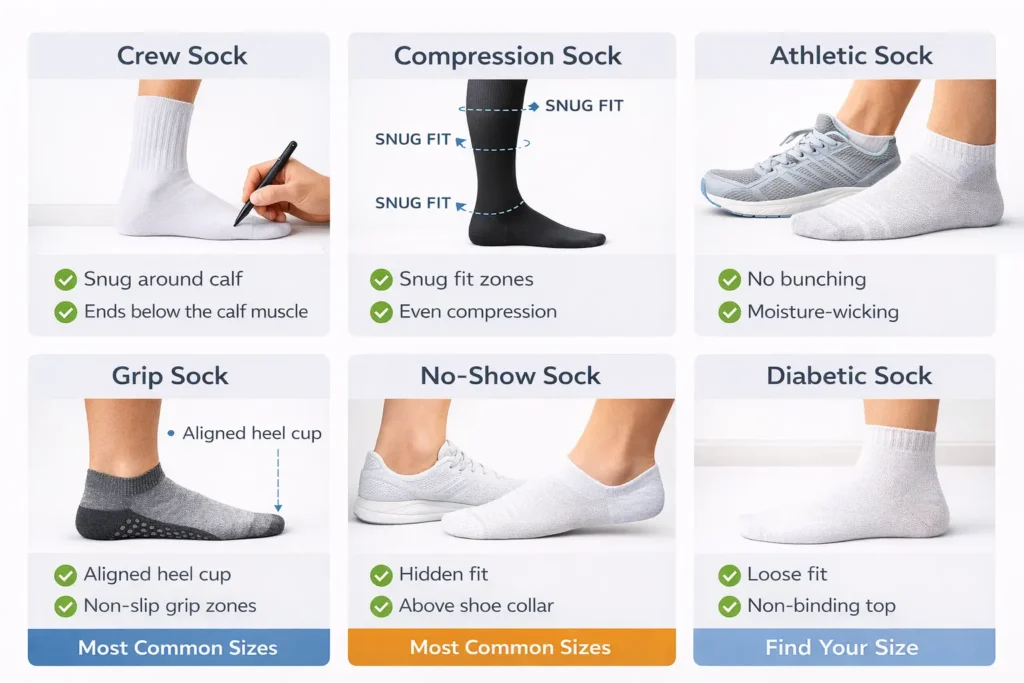
Standard crew socks should sit comfortably on your calf without sliding down or leaving deep impressions. The heel cup should align with your actual heel, and the toe seam should rest flat across your toes without bunching or pulling.
Ankle socks should cover your ankle bone while staying hidden under pants. Too small causes them to slip into shoes during wear. Too large creates excess fabric that bunches in your shoe and causes friction.
The elastic band should provide gentle security without cutting into your skin or restricting circulation. After wearing socks for 10 minutes, check for marks on your legs. Light impressions that disappear quickly are normal. Deep grooves lasting more than a few minutes indicate socks are too tight.
For optimal performance in standard socks, read our detailed guide on the best crew socks and the best ankle socks.
Compression Socks Sizing
Compression socks require the most precise sizing of any sock category because their therapeutic benefit depends on delivering specific pressure levels. Too loose provides inadequate compression. Too tight causes discomfort and potential circulation problems.
Compression sock sizing uses measurements beyond foot length. You must measure ankle circumference at the narrowest point, calf circumference at the widest point, and sometimes calf length from the floor to the bend of knee.
Compression levels are rated in millimeters of mercury (mmHg). Mild compression (8-15 mmHg) tolerates sizing variations better than medical-grade compression (20-30+ mmHg), which requires exact measurements. Always consult brand-specific sizing charts that include all required measurements.
When first wearing compression socks, they should feel snug but not painful. Difficulty putting them on is normal for higher compression levels, but once on, they shouldn’t cause numbness, tingling, or skin color changes.
For comprehensive compression sock guidance, see our detailed article on the best compression socks.
Athletic and Performance Socks
Athletic socks for running, cycling, hiking, and other sports should fit snugly without constriction. Excess fabric creates friction that causes blisters during repetitive motion. However, too-tight restrictions on blood flow can cause numbness during extended activity.
Many athletes size down in performance socks compared to casual socks because snug fit prevents movement inside shoes during sports. However, this depends on sock construction. Some performance brands engineer socks to fit true to size with minimal movement.
Cushioned athletic socks (for running or basketball) should provide padding without making shoes feel too tight. If your athletic shoes fit perfectly with thin socks but feel cramped with cushioned socks, you need larger shoes or thinner socks, not different sock sizes.
Moisture-wicking materials in athletic socks provide some sizing forgiveness because they don’t get heavy and sag when damp like cotton. For detailed athletic sock recommendations, check our guide on the best running socks and moisture-wicking socks.
Grip Socks for Yoga, Pilates, and Barre
Grip socks must fit snugly to prevent slipping during practice. Loose grip socks bunch and slide, negating their purpose. The heel cup alignment is critical because most grip socks use silicone patterns positioned to match specific foot areas.
Most practitioners size down in grip socks if between sizes. The snug fit ensures the grip zones stay in proper contact with the floor. However, socks shouldn’t be so tight that they restrict toe movement or cause cramping during exercise.
Toeless grip socks and five-toe designs have different sizing considerations than closed-toe styles. Toeless styles need precise length to position the opening correctly around toes. Five-toe socks require adequate toe pocket length to prevent cramping.
For grip sock specifics, explore our comprehensive guides on best grip socks, best grip socks for Pilates, and best grip socks for yoga.
No-Show and Liner Socks
No-show socks have the pickiest fit requirements because they must stay on your feet while remaining invisible above your shoes. Too small causes them to slip down and bunch under your arches. Too large means sock fabric shows above shoe collars.
The heel cup depth and shape matter more than overall size for no-show socks. A deep, well-shaped heel cup helps socks stay positioned correctly. Look for brands offering multiple height options (ultra-low for loafers, low for sneakers) rather than assuming one style works with all shoes.
Silicone heel grips are standard in quality no-show socks to prevent slipping. However, grips only work if the sock fits snugly enough to maintain skin contact. Loose no-show socks slip regardless of grip technology.
Diabetic and Medical Socks
Diabetic socks prioritize comfort and circulation over snug fit. They should feel looser than standard socks because they’re designed not to constrict. Non-binding tops stay up without elastic bands that could impede circulation.
Size diabetic socks using foot measurements taken when feet are at their most swollen, typically in the evening. This ensures socks accommodate fluctuations in foot size throughout the day without becoming uncomfortably tight.
Seamless toe construction in diabetic socks prevents irritation regardless of exact size. However, socks that are too large bunch and create friction points, while too-small socks restrict circulation. For diabetic sock guidance, see our article on best diabetic socks for women.
Dress Socks Sizing
Dress socks should fit smoothly under dress shoes without bunching. Over-the-calf dress socks should stay up without garters, which requires proper calf width sizing beyond just foot length.
Thin dress sock materials have less stretch than casual cotton socks, making precise sizing more important. Too small causes material stress that leads to faster wear and holes. Too large creates wrinkles visible in dress shoes.
Many dress sock brands offer quarter sizes or expanded size ranges to accommodate the less forgiving fit of thinner materials. When between sizes in dress socks, size up if wearing with thick insoles or if you have wide feet. Size down if you have narrow feet or prefer slim-fitting shoes.
Common Sock Sizing Problems and Solutions
Even with correct measurements, certain fit issues arise frequently. Here’s how to identify and solve common sock sizing problems.
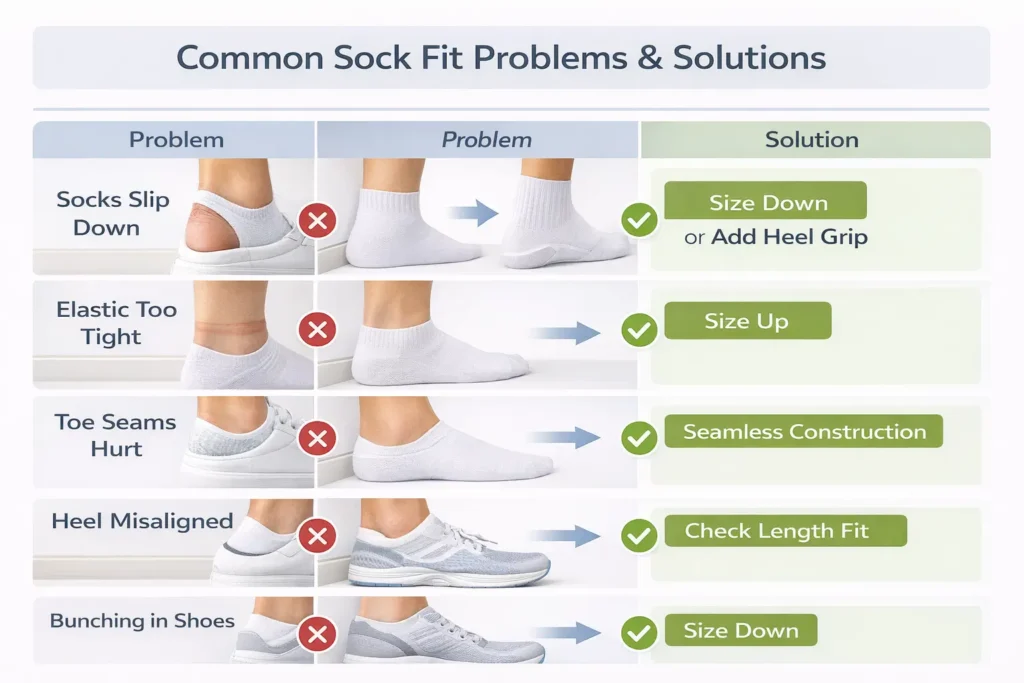
Problem: Socks Keep Slipping Down
Slipping socks indicates they’re too large, lack adequate elastic, or have a poorly shaped heel cup. This happens frequently with no-show socks and ankle socks because minimal fabric provides less surface area for grip.
Solutions:
- Size down if you’re in the middle of a size range
- Look for socks with silicone or rubber heel grips
- Choose socks with targeted arch compression bands
- Replace old socks where the elastic has degraded
- Try brands known for better heel cup construction
If slipping occurs only with certain shoes, the problem may be shoe fit rather than sock size. Shoes that are too large allow foot movement that pulls socks down.
Problem: Elastic Leaves Deep Marks
Deep elastic marks that don’t fade quickly indicate socks are too tight or use aggressive elastic. This is particularly problematic with compression socks, where excessive tightness can impede rather than improve circulation.
Solutions:
- Size up if marks persist more than 10 minutes after removal
- Look for socks with gradual compression rather than tight bands
- Try brands using soft-fold elastic rather than tight bands
- Wear socks slightly lower on the calf to avoid the tightest part of the elastic
- Consult a doctor if marks accompany swelling, numbness, or pain
For compression socks specifically, deep marks are expected at the top band, but shouldn’t occur along the entire sock. If you have full-leg marking, the compression level is too high, or the size is too small.
Problem: Toe Seams Cause Irritation
Toe seam irritation happens when seams bunch, sit incorrectly across toes, or use bulky construction. This indicates eitherthe wrong size or poor sock construction.
Solutions:
- Size up if toes feel cramped or seams pull tight across toe tops
- Choose socks with hand-linked toe seams (flattest construction)
- Look for seamless toe socks
- Try socks with toe pockets that allow for spread
- Wear socks inside out so seams sit away from skin (temporary fix)
Persistent toe irritation despite correct sizing suggests you need higher-quality socks with better seam construction. Budget socks often use thick, bulky seams that irritate regardless of size.
Problem: Heel Cup Doesn’t Align
Misaligned heel cups cause discomfort and premature wear because the shaped heel area sits in the wrong position. This typically means socks are the wrong length for your foot.
Solutions:
- Size down if the heel cup sits too far forward
- Size up if the heel cup sits behind your actual heel
- Look for brands offering half sizes or additional size gradations
- Try brands with deeper, more anatomically shaped heel cups
- Accept that some brands simply won’t fit your foot shape
Heel cup alignment matters most in athletic socks, grip socks, and no-show socks, where proper positioning affects performance. For casual crew socks, slight misalignment is less critical.
Problem: Socks Bunch in Shoes
Bunching indicates socks are too large, too thin for the shoe size, or made from materials that don’t hold shape when compressed.
Solutions:
- Size down if bunching occurs with properly fitted shoes
- Choose thicker socks if shoes have extra room
- Avoid pure cotton socks that compress easily
- Try socks with arch compression that reduces excess fabric
- Consider that shoes may be too large if multiple sock sizes bunch up
Bunching is particularly problematic in athletic activities because it creates friction hotspots that cause blisters. Athletic socks should fit smoothly in properly sized athletic shoes without any fabric folds.
Problem: Socks Are Too Short or Too Long
Length problems happen when sock height doesn’t match your leg proportions or when manufacturers’ definitions of “crew” or “knee-high” differ from your expectations.
Solutions:
- Check actual measurements (some brands provide sock height in inches)
- Size up for longer coverage, or if you have longer than average lower legs
- Look for brands offering “tall” versions of standard sizes
- Accept that sock heights vary and choose brands that match your needs
- For knee-high socks, measure from heel to knee bend and compare to product specs
Some people with longer or shorter than average legs for their foot size need to shop brands that separately specify foot size and leg length rather than assuming one size determines both.
For specific sock type solutions, consult our troubleshooting guides on why grip socks lose grip, and my grip socks keep slipping.
When to Size Up or Down
Knowing when to deviate from standard size recommendations prevents fit problems and improves sock performance.
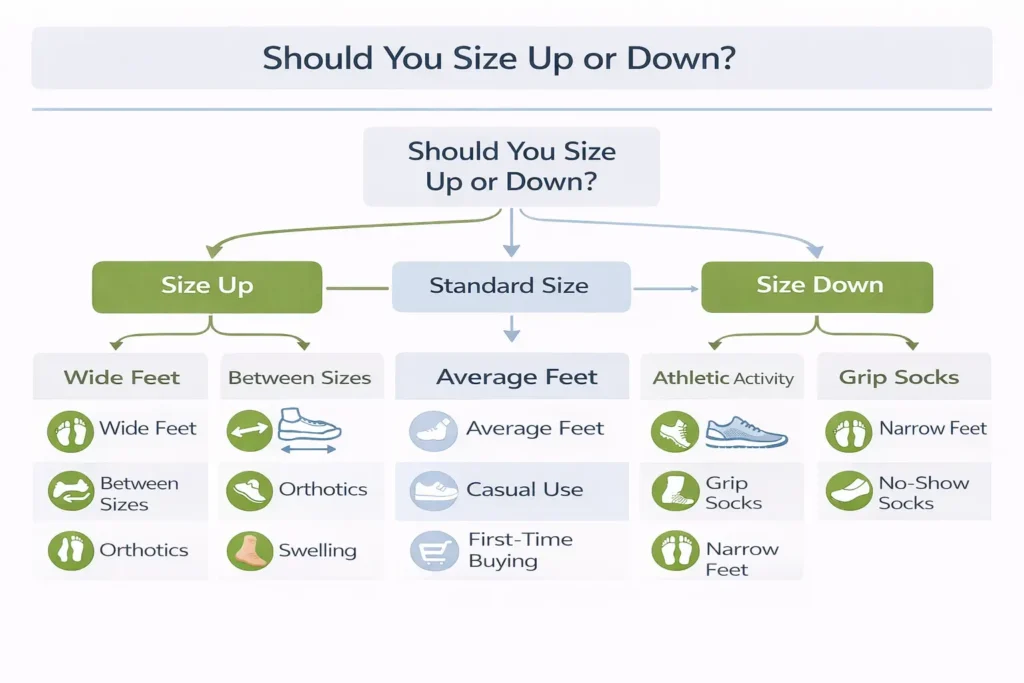
Size Up When:
You Have Wide Feet or High Arches. Standard sock sizing assumes average foot width and arch height. If you have wide feet or very high arches, the next size up provides the additional fabric needed to accommodate your foot shape comfortably without excessive stretching.
You’re Between Sizes. If your measurements fall exactly between two sizes (like a 9.5 inch foot at the break between Medium and Large), sizing up for casual and dress socks provides a more comfortable, forgiving fit. The extra room prevents tightness and extends sock life.
You Wear Thick Insoles or orthotics. Insoles and orthotics effectively make your foot larger within the shoe. Size up in socks to ensure they fit comfortably over orthotics without becoming too tight or creating pressure points.
You Have Circulation Issues oredema. Medical conditions causing swelling require sizing that accommodates fluctuating foot size. Size up to ensure socks remain comfortable when feet are at their most swollen, typically by evening.
You prefer a loose fit. Personal preference matters. If you dislike snug-fitting socks or find standard sizing too restrictive, sizing up is perfectly acceptable for casual and dress socks. Performance may suffer slightly in athletic contexts, but comfort takes priority for everyday wear.
For socks specifically designed for circulation and swelling, see our guide on compression socks for swollen feet.
Size Down When:
You’re Buying Athletic or Performance Socks. Athletic activities involve more foot movement than casual wear. Sizing down in performance socks prevents the micro-movements inside shoes that cause blisters during running, cycling, or sports. However, don’t size down so much that circulation is restricted.
You Want Grip Socks to Stay Secur.e Grip socks for yoga, Pilates, barre, and similar activities work best when snug. If you’re between sizes, size down to ensure grip zones stay in proper contact with the floor and socks don’t slip during practice.
No-Show Socks Keep Slippi.ng The minimal coverage of no-show socks means they rely heavily on snug fit to stay positioned. If no-show socks slip down frequently, sizing down often solves the prob,lem provided the smaller size doesn’t cause toe cramping.
You Have Narrow Feet Just as wide feet benefit from sizing up, narrow feet often need to size down for proper fit. Standard sizing may provide too much width, causing excess fabric that bunches in shoes.
Your Shoe Size is at the Top of a Size R.ange If you wear a size 9.5 shoe and the Medium sock size accommodates 6.5 to 9.5, you’re at the largest end of that range. Consider sizing up to Large instead of wearing the absolute maximum of Medium, particularly if socks feel tight.
When Standard Sizing Works
For most people in most sock categories, standard sizing based on shoe size works fine. If your feet are of average width, you don’t have medical conditions affecting foot size, and you’re buying from quality brands with accurate sizing charts, simply matching your shoe size to the chart proves proper fit.
The exceptions requiring special consideration are specialized socks (compression, athletic, grip, diabetic) and situations where your feet differ significantly from average proportions. For these cases, taking actual measurements and consulting detailed sizing charts becomes important.
Brand-Specific Sizing Differences
Even when following sizing charts carefully, you’ll discover that sock sizes vary significantly between brands. Understanding these brand tendencies helps you anticipate fit variations.
Why Brands Size Differently
Manufacturing standards, target demographics, and regional markets all influence how brands interpret Small, Medium, and Large. A brand primarily selling to European markets may use narrower size ranges than American brands because European feet tend to be narrower relative to length.
Additionally, some brands intentionally run small or large to target specific customers. Athletic brands often run slightly small because serious athletes prefer snug fits. Comfort brands may run large to appeal to customers who prioritize loose, relaxed fits over performance.
Material choices affect sizing consistency, too. Brands using high-elastane blends can offer broader size ranges because the fabric stretches more. Natural fiber brands need narrower, more precise size ranges because cotton and wool stretch less.
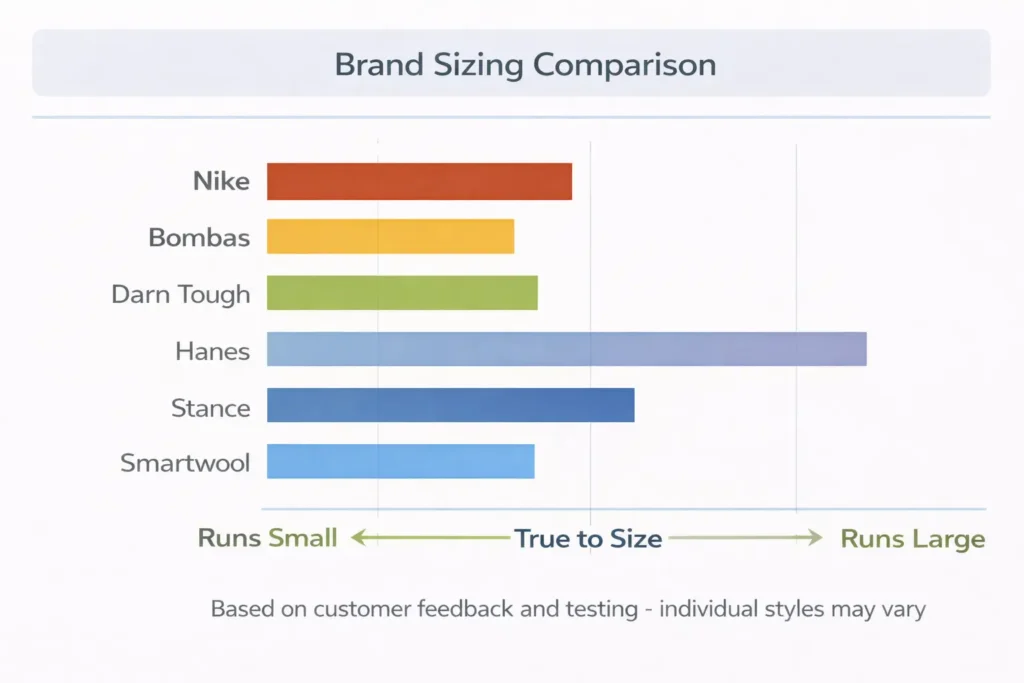
Common Brand Sizing Tendencies
While individual styles vary, certain brands have reputations for consistent sizing characteristics based on customer feedback and testing.
Brands That Typically Run Small:
- Nike (athletic socks run a half size small)
- Adidas (performance lines fit snug)
- Stance (fashion athletic styles fit tight)
- Features (engineered for snug performance fit)
Brands That Run True to Size:
- Bombas (reliable sizing across styles)
- Darn Tough (consistent Vermont manufacturing)
- Smartwool (accurate outdoor sock sizing)
- Gold Toe (traditional dress sock standard sizing)
And,Brands That Tend to Run Large:
- Hanes (casual comfort fit runs generous)
- Fruit of the Loom (value packs size loosely)
- Champion (basic athletic styles fit roomy)
These tendencies aren’t absolute rules. Always check product-specific reviews and sizing charts because brands update fit,s and different product lines within the same brand may size differently.
Reading Customer Reviews for Fit Information
Customer reviews provide invaluable real-world sizing information that charts can’t capture. Look for patterns in reviews mentioning sizing. If multiple reviews say “runs small, size up,” that’s actionable intelligence.
Pay attention to reviewers who mention their shoe size and the sock size they ordered. Comments like “I wear size 9 shoes and Medium was perfect” or “Size 10 feet, had to exchange Medium for Large” give specific data points.
However, filter reviews through context. Someone complaining that socks are too tight when they ordered athletic compression socks may simply not understand that a snug fit is intentional. Similarly, “too loose” complaints about diabetic socks may reflect correct sizing for that sock type.
International Brand Considerations
European and Asian brands often fit differently from American brands because they’re designed for different average foot shapes. European brands may run more narrowly. Asian brands typically offer smaller size ranges overall and may lack sizes for larger Western feet.
When ordering from international brands, check whether sizing charts use US conversions or native sizing. If a European brand shows sizes as 39-42 and 43-46, those are EU sizes requiring conversion. If they show Small/Medium/Large with US shoe sizes listed, they’ve already done the conversion.
Read international brand reviews from customers in your region. Fellow Americans buying European brands will note fit differences relevant to you, while European customer reviews may not translate directly.
For brand-specific insights on popular sock brands, see our detailed reviews on Tavi grip socks and Bombas no-show socks.
Special Sizing Considerations
Certain situations require additional thought beyond standard sizing guidelines. These special considerations ensure proper fit in unique circumstances.
Sizing for Medical Conditions
Medical conditions affecting feet require careful sizing to avoid exacerbating problems or reducing therapeutic benefits.
Diabetes: Choose socks specifically designed for diabetic needs with non-binding tops and seamless construction. Size using measurements taken when feet are most swollen. Diabetic socks should feel looser than regular socks because they prioritize circulation over a snug fit. Never size down in diabetic socks.
Edema and Swelling: Feet that swell significantly during the day need socks sized for maximum swelling. Measure feet in the evening and choose sizes based on those measurements. Compression socks can help manage edema, but require proper fitting from measurements, not just shoe size.
Neuropathy: Nerve damage reduces sensation, making it difficult to notice if socks are too tight and restricting circulation. Size up and choose socks without aggressive elastic bands. Check your feet regularly for any marks or irritation you might not feel.
Arthritis: Joint conditions may make putting on snug socks difficult. Size up slightly for easier donning, or choose socks with wider openings. Compression socks designed for arthritis often include features like pull-on loops.
Plantar Fasciitis: Arch support socks and compression socks can help, but require proper sizing to provide correct support positioning. Too large means the support sits in the wrong location. Too small causes excessive pressure.
For medical sock guidance, explore our detailed articles on diabetic socks for women and compression socks for plantar fasciitis.
Sizing for Children and Growing Feet
Children’s feet grow rapidly, creating unique sizing challenges. Buying the right size means balancing current fit against how quickly kids outgrow socks.
Growth Allowance: For everyday socks, buying at the top of the size range or even slightly large allows room for growth. However, athletic socks should fit properly now, rather than being too large, as excess fabric causes blisters during sports.
Frequent Measurement: Children’s foot sizes can change every few months during growth spurts. Measure regularly rather than assuming last month’s size still applies. Socks that fit one month may be uncomfortably small the next.
Quality Matters More: Because children outgrow socks quickly anyway, some parents opt for budget multipacks. However, quality socks that fit properly prevent blisters and foot problems even during brief wear periods. Consider this especially for athletic and school socks worn daily.
Grip Socks for Kids: Children doing gymnastics, dance, or trampoline activities need properly fitted grip socks. Too large causes slipping despite grip patterns. For kids’ grip sock guidance, see our article on the best toddler socks with grips.
Sizing During Pregnancy
Pregnancy causes foot changes that affect sock sizing, particularly in later trimesters.
Swelling: Feet typically swell during pregnancy, especially in the third trimester. Size up in regular socks to accommodate swelling. Measure feet when most swollen (usually evening) for accurate sizing.
Compression Socks: Many pregnant women use compression socks to reduce swelling and prevent varicose veins. Pregnancy-specific compression socks account for the changing body shape and increased swelling. Standard compression sizing may not work properly during pregnancy.
Arch Changes: Pregnancy hormones loosen ligaments, sometimes causing arch flattening that changes foot length and width. Remeasure feet duringthe second and third trimesters as arch changes occur.
Post-Pregnancy: Feet may return to pre-pregnancy size after delivery, or changes may be permanent. Don’t assume pregnancy socks will fit long-term or that pre-pregnancy socks will immediately fit again postpartum.
Sizing for Athletes and High-Performance Activities
Serious athletes have different sock sizing priorities than casual wearers because performance depends partly on proper fit.
Sport-Specific Needs: Running socks should fit snugly to prevent blisters during repetitive motion. Cycling socks need a smooth fit inside cycling shoes. Basketball socks require cushioning that doesn’t make shoes too tight. Each sport has specific fit requirements within the general “athletic sock” category.
Moisture Management: Athletes who sweat heavily need moisture-wicking socks, but these perform best when properly fitted. Too loose means the fabric doesn’t contact the skin efficiently to wick moisture. Too tight restricts circulation needed during exertion.
Blister Prevention: For endurance activities like marathons or long hikes, preventing blisters is critical. This often means sizing down slightly for snugger fit that prevents movement, combined with seamless construction and moisture-wicking materials.
Compression for Recovery: Some athletes use compression socks for recovery after intense training. These require the same precise sizing as medical compression socks because proper pressure levels depend on accurate measurements.
For sport-specific sock recommendations, see our guides on best running socks, best cycling socks, and best hiking socks.
Sizing for Work Requirements
Certain occupations have sock requirements that affect sizing decisions.
Healthcare Workers: Nurses and other medical professionals often wear compression socks during long shifts. These need proper compression sock sizing based on measurements, not just shoe size. Additionally, moisture-wicking properties matter for all-day comfort, which works best with a proper fit.
Construction and Labor: Workers on their feet all day need cushioned socks that fit properly within steel-toed or work boots. These boots often run large, tempting workers to size up in socks to fill space. However, properly fitted boots with correctly sized cushioned socks work better than oversized socks compensating for oversized boots.
Office Professionals: Dress sock sizing matters for appearance and comfort during long days sitting or standing. Over-the-calf dress socks must fit the calf circumference properly to stay up without garters.
Athletes and Coaches: Professional and semi-professional athletes need performance sock sizing optimized for their specific sports, often meaning sizing down for a snug athletic fit.
For occupation-specific recommendations, see our article on compression socks for nurses.
Sizing for Seasonal Considerations
Weather and seasonal activities affect sock choices and sizing.
Winter Boots: Heavy winter boots often have room for thick socks. However, don’t assume you need larger sock sizes. Instead, choose socks with appropriate thickness (medium or heavy weight) in your standard size rather than oversizing thin socks.
Summer Activities: Hot weather activities with lots of sweating benefit from moisture-wicking socks in proper sizes. Too large means moisture stays against skin longer. Too small restricts cooling airflow.
Layering Socks: Some outdoor enthusiasts layer thin liner socks under thicker hiking or winter socks. This requires considering combined thickness when choosing outer sock size. The liner adds bulk, so outer socks may need to size up.
Seasonal Swelling: Some people experience more foot swelling in summer heat. If this applies to you, consider having separate summer and winter sock sizes, or choose socks with more stretch to accommodate seasonal variations.
Frequently Asked Questions About Sock Sizing
Basic Sizing Questions
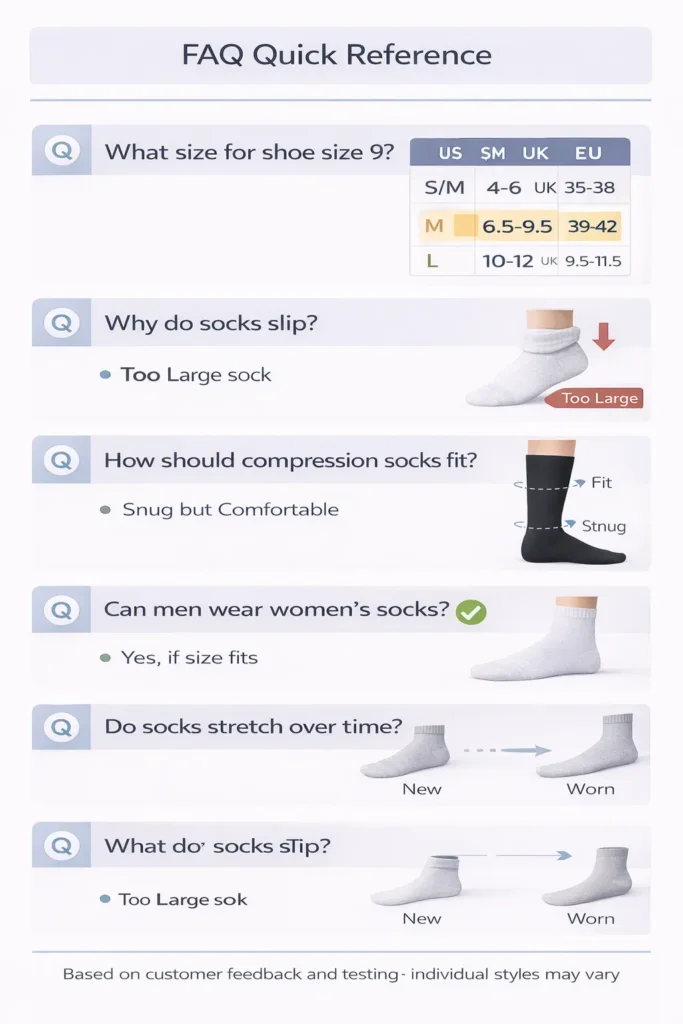
What size sock should I buy for size 9 shoes? For US women’s size 9 shoes, buy Medium socks (typically sized 6.5-9.5). For US men’s size 9 shoes, buy Large socks (typically sized 9-11). Always check the specific brand’s sizing chart because ranges vary.
Are sock sizes the same as shoe sizes? No, sock sizes are ranges that accommodate multiple shoe sizes. One sock size (like Medium) typically fits 3-4 shoe sizes. Socks use Small/Medium/Large or numerical ranges rather than individual sizes like shoes.
Can men wear women’s socks and vice versa? Yes, if the size fits. Men’s and women’s socks differ mainly in size ranges and sometimes in proportions (women’s socks may be narrower). If the measurements work for your feet, gender labels don’t matter functionally.
Do I need different sizes for different sock types? Sometimes. Compression socks require specific measurements beyond shoe size. Athletic socks may fit differently than casual socks from the same brand. Grip socks often work best sized down for snug fit. Check sizing for each sock type rather than assuming one size fits all your sock needs.
How do I know if my socks are the right size? Properly sized socks feel comfortable without tightness, the heel cup aligns with your heel, there’s no excess bunching in shoes, elastic provides security without leaving deep marks, and toes have room without cramping.
Measurement and Conversion Questions
How do I measure my foot for socks? Stand barefoot on paper against a wall. Mark your longest toe. Measure from the wall to mark. Do this for both feet and use the larger measurement. Measure in the evening when feet are slightly swollen for the most accurate functional size.
What does EU size 39-42 mean in US sizing? EU sock sizes 39-42 roughly equal US women’s 8-10 or US men’s 6-8. However, because EU shoe sizes themselves differ from US, always check if the sizing chart shows EU-to-US conversion or requires you to convert separately.
Do sock sizes vary between countries? Yes. The US uses Small/Medium/Large based on US shoe sizes. UK uses similar categories based on UK shoe sizes. EU uses numbered ranges based on EU shoe sizes. Japan and other Asian markets use different systems. Always check the specific region’s sizing chart.
How do I convert between US and UK sock sizes? UK and US sock sizing use similar Small/Medium/Large categories, but UK shoe sizes differ from US sizes. A UK Medium sock (typically shoe size 6-8) roughly equals US Medium. However, verify with brand-specific charts because conversions aren’t perfectly standardized.
Are one-size-fits-all socks actually one size? One size fits all socks typically fit US women’s 6-10 or men’s 6-12 due to high elasticity. However, they rarely fit optimally at the extremes of that range. People with very small or very large feet usually need sized socks for proper fit.
Fit Problem Questions
Why do my socks keep falling? Socks slip down because they’re too large, the elastic has weakened, the heel cup lacks proper shaping, or they lack grip features like silicone. Try sizing down, replacing old socks with worn elastic, or choosing brands with better heel construction.
Why do compression socks leave marks on my legs? Light marks that fade within minutes are normal from compression. Deep marks lasting 30+ minutes suggest socks are too tight, or the compression level is too high for your needs. Try sizing up or choosing lower compression (15-20 mmHg instead of 20-30 mmHg).
My socks bunch up in my shoes. What’s wrong? Bunching indicates socks are too large for your shoes, too thin for the shoe volume, or made from materials that compress easily. Try sizing down, choosing thicker socks, or selecting socks with arch compression that prevents excess fabric.
The heel never lines up on my socks. Why? Misaligned heel cups mean the sock length doesn’t match your foot length. Size up if the heel cup sits behind your actual heel. Size down if it sits too far forward. Some brands simply won’t match your foot proportions.
Can socks be too tight? Yes. Socks causing numbness, tingling, pain, or deep marks that last 30+ minutes are too tight. This can restrict circulation and cause foot problems. Size up or choose socks with gentler elastic and more stretch.
Specialty Sock Questions
How should compression socks fit? Compression socks should feel snug but not painful. Difficulty putting them on is normal for higher compression levels. Once on, they shouldn’t cause numbness, skin color changes, or pain. Compression depends on precise sizing using ankle and calf measurements, not just shoe size.
Do grip socks run small? Many grip sock brands run true to size, but optimal performance often requires sizing down if you’re between sizes. The snug fit keeps grip patterns in proper contact with the floor. However, don’t size down so much that toes cramp or circulation restricts.
Should diabetic socks feel loose? Yes, diabetic socks should feel looser than regular socks because they’re designed not to constrict. Non-binding tops and overall relaxed fit prioritize circulation. Size using measurements taken when feet are most swollen.
How tight should athletic socks be? Athletic socks should fit snugly without constriction. You want minimal movement inside shoes to prevent blisters, but not so tight that circulation is impeded or feet go numb during activity. Many athletes size down slightly from casual sock size.
Do no-show socks require special sizing? No-show socks need a precise fit because minimal coverage means they rely on a snug fit and heel grips to stay positioned. If between sizes, size down. Check that the heel cup depth and shape match your heel for proper grip.
Shopping and Brand Questions
Should I buy socks in store or online? Both work. In-store allows trying socks on (over existing socks) to check basic fit. Online offers better selection and reviews with sizing information. For first purchases of unfamiliar brands, in-store shopping reduces return hassles. For restocking known brands, online is convenient.
Do expensive socks fit better than cheap ones? Price doesn’t guarantee fit, but quality socks typically feature better heel cup construction, more durable elastic, and more precise sizing consistency between pairs. Cheap socks often have loose size ranges and construction that doesn’t hold shape, leading to fit problems.
How many sock sizes should I try before finding the right fit? Most people find a proper fit within 1-2 size attempts if using measurements and brand sizing charts. However, some foot shapes may require trying 2-3 brands before finding one with proportions matching their feet.
Can I return socks if they don’t fit? Return policies vary by retailer. Many allow returns of unworn, unwashed socks in original packaging. Some brands offer satisfaction guarantees or trial periods. Always keep packaging and receipts until you’ve tested the fit.
Should I buy multiple sizes to try at home? If shopping online from unfamiliar brands, ordering two sizes can save return shipping hassle. Try both, return the one that doesn’t fit. However, this requires upfront cost for both sizes and assumes the retailer accepts returns.
Care and Longevity Questions
Do socks stretch out over time? Yes, elastic degrades with wear and washing. Socks that fit perfectly when new may become loose after months of use. This is normal wear. Replace socks when they no longer stay up properly, or the elastic feels weak.
Will washing socks change their size? Hot water and high heat drying can shrink socks, while aggressive washing can stretch them. Follow care instructions (usually cold wash, low heat, or air dry) to maintain size. New socks may shrink slightly inthe first wash, even with proper care.
How long should properly sized socks last? Quality socks in correct sizes typically last 6-12 months with regular wear and proper care. Budget socks may last 2-4 months. Specialized socks like compression or athletic socks often last longer because they’re engineered for durability.
Does the sock material affect how long the size stays accurate? Yes. Synthetic blends with elastane/spandex maintain size longer than pure natural fibers. However, natural fibers like merino wool are more forgiving of size variations because they adapt to foot shape better than rigid synthetics.
Should I replace socks when the size changes? Replace socks that have stretched enough to slip down, become loose, or no longer stay in position. Continuing to wear ill-fitting socks causes foot problems, blisters, and premature sock wear in remaining pairs.
Related Resources
Understanding sock sizing connects to broader topics about choosing and caring for specialized socks. Exploring these related areas helps you make informed decisions about your complete sock wardrobe.
Learning about specific sock types helps you understand why each requires particular sizing considerations. Our comprehensive guide on best grip socks explains why grip socks need snug fits for optimal traction performance.
Comparing different sock heights and styles reveals how sizing requirements change based on sock design. Reviewing best ankle socks versus best crew socks versus best knee-high socks shows how height affects fit and sizing.
Understanding sock materials explains why sizing varies between fabric types. Our detailed article on the best moisture-wicking socks covers how synthetic blends size differently from natural fibers and why this matters for athletic performance.
Exploring compression sock specifics provides the detailed measurement guidance this specialized category requires. See our comprehensive guides on the best compression socks and compression socks for swollen feet for measurement instructions and size selection.
Learning about specialized athletic socks shows how performance requirements affect sizing decisions. Check our detailed reviews of the best running socks and the best cycling socks for sport-specific fit guidance.
For readers interested in grip socks for studio workouts, our guides on the best grip socks for Pilates and best grip socks for yoga explain the snug fit requirements these activities demand.
Understanding how to care for socks helps maintain the proper size through extended use. Our comprehensive guide on how to wash grip socks provides care instructions that apply to all sock types and help preserve sizing.
Sock Sizing Quick Reference Table
Here’s a comprehensive sizing reference to quickly find your size across different regions and sock types:
| Foot Length (inches) | Foot Length (cm) | US Women’s Shoe | US Men’s Shoe | Sock Size (US) | Sock Size (UK) | Sock Size (EU) |
|---|---|---|---|---|---|---|
| 8.5–9.0 | 21.5–23.0 | 5–6 | 3–4 | Small | Small | 35–38 |
| 9.0–9.5 | 23.0–24.0 | 6.5–7.5 | 4.5–5.5 | Small / Medium | Small / Medium | 35–38 |
| 9.5–10.0 | 24.0–25.5 | 8–9 | 6–7 | Medium | Medium | 39–42 |
| 10.0–10.5 | 25.5–26.5 | 9.5–10.5 | 7.5–8.5 | Medium | Medium | 39–42 |
| 10.5–11.0 | 26.5–28.0 | 11–12 | 9–10 | Large | Large | 43–46 |
| 11.0–11.5 | 28.0–29.0 | 12.5+ | 10.5–11.5 | Large / XL | Large / XL | 43–46 |
| 11.5–12.0 | 29.0–30.5 | N/A | 12–13 | Extra Large | Extra Large | 47–50 |
| 12.0+ | 30.5+ | N/A | 13.5+ | XXL | XXL | 47–50 |
Standard Crew/Ankle Socks: Follow the table directly based on foot length
Compression Socks: Also measure ankle circumference (narrowest point) and calf circumference (widest point). Consult brand compression sizing charts with these measurements.
Athletic/Running Socks: Consider sizing down if between sizes for a snugger performance fit
Grip Socks (Yoga/Pilates/Barre): Size down if between sizes for secure non-slip fit
No-Show Socks: Size down if experiencing slipping issues, especially with low-collar shoes
Diabetic Socks: Measure when feet are most swollen; choose non-binding styles that feel looser than standard socks
Dress Socks: For over-the-calf styles, also measure calf circumference at the widest point
Final Thoughts on Finding Your Perfect Sock Size
Sock sizing seems simple at first glance, but it involves more nuance than most people realize. The combination of inconsistent size standards across brands, different fit requirements for specialized socks, and individual foot shape variations means finding your perfect size requires understanding beyond just matching your shoe size to a chart.
The investment in proper sock sizing pays immediate dividends through improved comfort, better sock performance, and longer sock life. Socks that fit correctly feel invisible during wear because they’re not slipping, bunching, cutting circulation, or causing any of the common discomforts associated with the wrong sizes. Meanwhile, properly fitted specialized socks like compression socks or grip socks deliver their intended benefits effectively rather than failing because of sizing errors.
Taking the time to measure your feet accurately, understanding your specific needs based on sock type and activity, and consulting brand-specific sizing charts prevents the frustration of buying socks that don’t work. While this requires more effort than grabbing whatever Medium socks are on sale, the result is a sock drawer full of properly fitting socks that make every day more comfortable.
Remember that sizing isn’t static. Feet change over time due to age, weight changes, pregnancy, medical conditions, and the natural variations throughout each day as feet swell and contract. Remeasuring periodically and reassessing your sock sizes ensures your socks continue fitting properly, rather than assuming the size you wore five years ago still works today.