


My friend spent 16 dollars on premium grip socks after her yoga instructor insisted they were essential equipment. She complained about the price for weeks, calling them overpriced novelties that studios pushed for profit. Three months later, during our coffee catch-up, I asked if she still regretted the purchase. She paused, then admitted the socks had prevented at least a dozen near-falls during challenging transitions,s and her balance confidence had improved noticeably. When I asked if she would buy them again, knowing what she knows now, she answered immediately: absolutely. That conversation made me realize the question “are grip socks worth it?” depends entirely on measuring actual value rather than just comparing prices to regular socks.
The grip sock market has exploded over the past decade, with options ranging from eight-dollar multipacks to forty-dollar premium pairs. This price variation, combined with conflicting claims about benefits,s creates genuine confusion about whether grip socks represent worthwhile investments or marketing hype. However, evaluating worth requires looking beyond sticker prices to examine measurable benefits, injury prevention value, performance improvements, and cost per use across different activities and user types. Consequently, this analysis breaks down the real economics of grip socks through evidence-based assessment of costs versus benefits for various situations.
Understanding the Real Cost of Grip Socks
Basic grip socks from major retailers typically cost eight to fifteen dollars for multipacks, translating to three to five dollars per pair. These budget options provide fundamental grip features, including silicone or rubber dots covering key foot areas and adequate construction for light recreational use. However, the materials and manufacturing quality usually result in shorter lifespans of two to four months with regular use. Therefore, the per-use cost increases when frequent replacement becomes necessary. For comparison context, see our best grip socks under 20 dollars collection.
Premium grip socks from specialized brands cost fifteen to forty dollars per pair, with most quality options falling in the 18 to 25-dollar range. These higher prices reflect better materials, more durable construction, and thoughtful design features that extend usable life to six to twelve months or longer. Additionally, premium options often provide superior grip performance through advanced material formulations and optimized pattern designs. Consequently, while initial costs seem high, the extended lifespan and better performance often deliver lower per-use costs than budget alternatives.
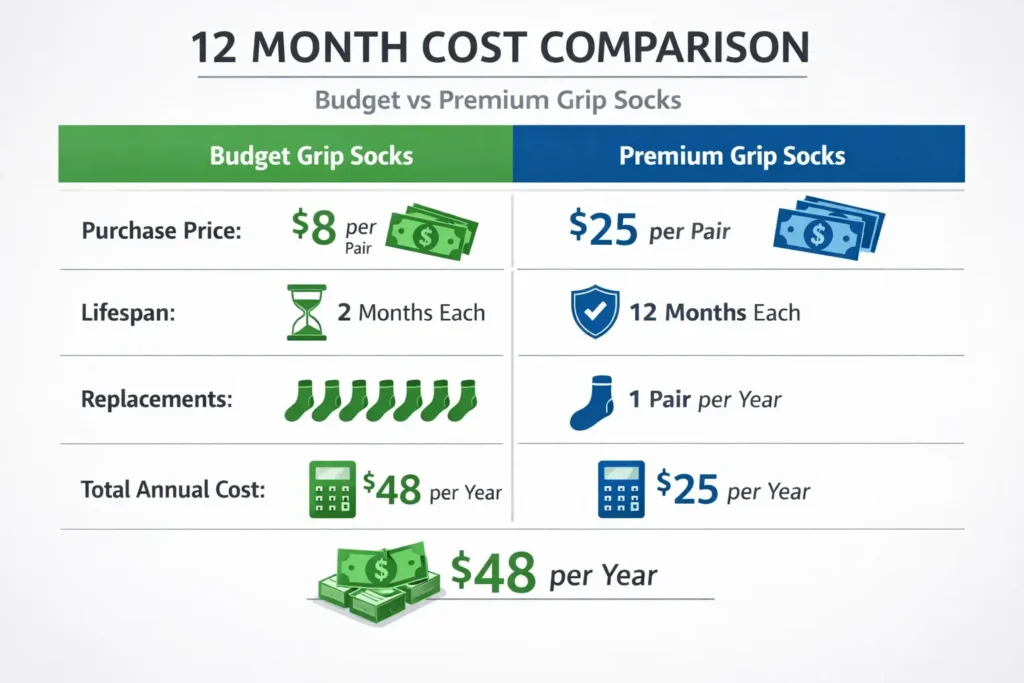
The total ownership cost includes replacement frequency beyond just the purchase price. Someone buying eight-dollar socks every two months spends approximately forty-eight dollars annually. Meanwhile, someone buying twenty-five-dollar premium socks that last twelve months spends just twenty-five dollars a year. This calculation illustrates why evaluating worth necessitates considering durability and replacement cycles, rather than just comparing initial prices. According to consumer product research from Consumer Reports, the total cost of ownership often differs dramatically from the purchase price for items requiring periodic replacement.
Measurable Safety Benefits
Fall prevention represents the most significant measurable benefit that grip socks provide. Studies from the National Safety Council indicate that slips and falls account for over eight million emergency room visits annually in the United States. Grip socks reduce fall risk on smooth floors by increasing friction coefficients between feet and surfaces by 40-60% compared to regular socks. For elderly individuals, people with balance challenges, or anyone on slippery flooring, this injury prevention alone justifies the cost through avoided medical expenses and lost work time.
The injury cost avoidance calculation reveals substantial value. A single emergency room visit for a fall-related injury costs an average of $3,000 to $5,000, according to Healthcare Cost and Utilization Project data. Physical therapy for sprain or fracture recovery adds another $1,000 to $3,000 over several months. Meanwhile, lost wages from injury recovery can exceed these direct medical costs. Therefore, if grip socks prevent even one injury requiring medical attention over several years, they delivera dramatic positive return on investment regardless of initial purchase price.
Confidence and fear reduction provide less tangible but equally important safety benefits. People who fear falling naturally move more cautiously, potentially missing developmental opportunities or activity benefits. Children learning movement skills, the elderly maintaining mobility, and fitness enthusiasts pushing limits all gain confidence from reliable traction. This psychological benefit enables fuller participation in activities that improve health and quality of life, creating value beyond simple injury prevention.
Performance Enhancement in Athletic Activities
Yoga and Pilates practitioners gain measurable stability improvements from grip socks. Research published in the Journal of Sports Sciences found that participants performing balance poses showed 23% less foot slippage when wearing grip socks compared to barefoot on mats. This enhanced stability allows holding poses longer and transitioning more confidently between positions. Additionally, the mental focus freed from balance concerns allows deeper engagement with breath work and body awareness. For dedicated practitioners attending multiple classes weekly, these performance benefits compound over time. See our best grip socks for Pilates guide for sport-specific options.
Dance and martial arts benefit from improved pivot control and explosive movement stability. Dancers executing quick turns need reliable foot traction that grip socks provide on studio floors. Similarly, martial artists practicing footwork drills maintain better positioning with a grip that prevents unwanted sliding. The performance improvements translate to faster skill progression and reduced frustration during technical practice. For competitive athletes, these advantages potentially impact performance outcomes worth far more than sock costs.

Ball sport athletes see mixed results depending on specific activity demands. Football and basketball players often report better footing control inside shoes, though some find the added grip creates unwanted friction. The value depends heavily on personal preference and specific position requirements. Therefore, athletes should test grip socks in their sport before bulk purchasing. For football-specific analysis, check our best grip socks for football breakdown.
Cost Per Use Analysis Across Different Users
Daily studio practitioners achieve excellent cost per use economics. Someone attending five yoga or Pilates classes weekly who spends twenty dollars on grip socks lasting six months pays approximately fifteen cents per use. This minimal per-session cost for measurable safety and performance benefits represents clear positive value. Additionally, many studios require or strongly recommend grip socks, making the purchase necessary rather than optional for class participation.
Occasional recreational users see less compelling economics but still reasonable value. Weekend yoga enthusiasts or people doing home workouts two to three times weekly might spend twenty dollars on socks lasting a year or longer. The resulting ten to fifteen cents per use still seems reasonable for added safety and comfort. However, the absolute cost savings compared to barefoot practice become less significant when use frequency decreases.
Home-only users face different value calculations. People practicing exclusively on personal mats in their homes may find that grip socks provide minimal benefit over barefoot practice. The controlled environment and familiarity with specific surfaces reduce fall risk. Gripsocks address. However, those with hardwood or tile floors still benefit from grip, preventing household slips beyond just exercise use. Therefore, home practitioners should evaluate grip socks as general household safety equipment rather than purely exercise gear.

Who Actually Needs Grip Socks
Elderly individuals gain disproportionate value from grip socks due to fall consequences and risk factors. Balance naturally declines with age, while injury recovery becomes slower and more complicated. A fall that causes minor bruising in younger people can result in serious fractures requiring surgery and rehabilitation in seniors. The Centers for Disease Control reports that one in four Americans aged 65+ falls annually, with many falls occurring at home on smooth floors. Therefore, grip socks represent essential safety equipment for elderly populations where modest costs prevent potentially catastrophic injuries.
People with neurological conditions affecting balance benefit substantially from grip sock traction support. Parkinson’s disease, multiple sclerosis, stroke recovery, and peripheral neuropathy all compromise stability and increase fall risk. Grip socks provide external support that partially compensates for reduced proprioception and motor control. While socks cannot replace medical treatment or therapy, they add a safety layer during daily activities and exercise routines. The independence and confidence they enable often proves more valuable than any cost consideration.
Studio fitness enthusiasts get clear value from grip socks through improved performance and studio requirement compliance. Most yoga, Pilates, and barre studios either require grip socks or strongly encourage them for hygiene and safety reasons. Additionally, the performance benefits during class justifythe costs for people taking their practice seriously. The combination of mandatory use and measurable improvements makes grip socks a worthwhile investment for regular studio participants.
Children and toddlers on smooth home floors benefit from grip sock fall prevention during active play. Young children lack refined motor control and judgment about movement speed on slippery surfaces. Grip socks allow safe, energetic play on hardwood and tile without parents constantly worrying about falls. The peace of mind for parents often outweighs modest sock costs. For toddler-specific options, see our best toddler socks with grips guide.
Who Can Skip Grip Socks
Carpet-exclusive practitioners gain minimal benefit from grip socks because carpet already provides natural traction. If your home practice space features plush carpet and you rarely encounter smooth floors during workouts, regular socks or barefoot practice works adequately. The grip sock investment only makes sense if you occasionally train on smooth surfaces or want options for different environments.
Athletes in shoes full-time may findthat grip socks provide marginal benefits not justifying costs. Runners, gym-goers, and outdoor athletes wearing athletic shoes throughout activities already have footwear traction. While some athletes report benefits from grip socks inside shoes, many notice no difference. Therefore, shoe-based athletes should test grip socks before buying multiple pairs.

Barefoot devotees who prioritize direct floor contact may philosophically oppose grip socks. Some yoga traditions emphasize barefoot practice for grounding and connection reasons. Additionally, certain biomechanics research suggests barefoot movement provides proprioception benefits that shoes or socks cannot match. People strongly committed to barefoot practice should honor those preferences rather than adopting grip socks just because studios recommend them.
Budget-constrained beginners can delay grip sock purchases until determining activity commitment. Someone trying their first few yoga classes might reasonably use regular socks or barefoot practice while deciding if the activity fits their lifestyle. However, if slipping during class creates safety concerns or hinders enjoyment, grip socks should become early priorities. The modest investment protects against injury and improves experience during the evaluation period.
Hidden Costs and Considerations
Maintenance requirements add minor ongoing costs beyond the purchase price. Grip socks need more careful washing than regular socks to preserve effectiveness. Additionally, air drying rather than machine drying extends lifespan but requires more time and planning. Some people find these care requirements annoying enough to offset grip benefits. The maintenance effort represents a hidden cost not reflected in the purchase price.
Replacement timing creates decision complexity that costs time and attention. Determining when grip socks have degraded enough to require replacement takes judgment and testing. Some people replace too early, wasting the remaining useful life. Others wait too long, continuing to use an inadequate grip that compromises safety. This ongoing evaluation responsibility represents a minor but real cognitive cost.
Storage and organization needs increase with grip sock ownership. Keeping grip socks separate from regular socks prevents accidentally wearing the wrong types for activities. Additionally, preventing grip sock contamination or damage during storage requires some attention. For people with minimal storage space or organizational challenges, these practical considerations may feel burdensome.
Honest Limitations of Grip Socks
Grip socks cannot replace proper flooring maintenance and hazard reduction. Extremely slick, dirty, or wet floors overwhelm even excellent grip sock traction. Relying on grip socks while ignoring floor safety creates false confidence and continued risk. Therefore, grip socks work best as one component of comprehensive fall prevention rather than standalone solutions.
Individual variation means not everyone experiences identical benefits. Some people naturally have better proprioception and balance, requiring less external traction support. Additionally, personal preferences about foot sensations mean some individuals find grip socks distracting or uncomfortable despite objective performance improvements. The subjective experience significantly affects perceived value beyond measurable benefits.
Grip effectiveness degrades over time regardless of maintenance quality. Even premium socks eventually lose grip through polymer degradation and contamination accumulation. This inevitable decline means grip socks represent recurring expenses rather than one-time purchases. People must accept ongoing replacement costs as part ofthe total value calculation. For more on extending grip life, see our why grip socks lose grip guide.
Comparing Alternatives to Grip Socks
Barefoot practice costs nothing but provides limited fall protection on smooth surfaces. The direct floor contact offers maximum proprioception and natural movement. However, hygiene concerns in studio settings and fall risks on slippery floors create significant drawbacks. Additionally, some studios prohibit barefoot practice for sanitation reasons. Therefore, barefoot works well in controlled home environments but becomes impractical or unsafe in many situations.
Yoga mat towels provide traction for sweaty practices but add bulk and maintenance complexity. Microfiber towels with grippy bottoms reduce sliding on mats during hot yoga or intense flows. However, they require washing after each use, fold awkwardly during practice, and cost fifteen to thirty-five dollars. The ongoing washing burden and space they occupy on mats make them less convenient than grip socks for most practitioners.

Regular athletic socks cost less but provide essentially no traction benefits. The three-to-eight-dollar price advantage comes with dramatically increased fall risk on smooth surfaces. For activities where slipping poses genuine danger, the cost savings become irrelevant compared to injury risks. Therefore, regular socks only make sense for carpeted environments or activities where traction barely matters.
Specialty footwear like Pilates shoes or dance slippers offers maximum protection and performance but costs significantly more. Quality specialized footwear ranges from forty to one hundred twenty dollars or more. While these options provide superior features for dedicated practitioners, the price barrier excludes casual participants. Grip socks fill the middle ground between barefoot and specialized footwear for people wanting better performance without major investment.
Evidence-Based Value Assessment
Research on fall prevention interventions consistently ranks footwear modifications among the most cost-effective safety measures. Studies published in the Injury Prevention journal found that simple traction improvements reduced fall rates by 30-50% across various populations. When injury costs average thousands of dollars per incident, interventions costing under twenty-five dollars show exceptional return on investment from purely financial perspectives.
Biomechanics research demonstrates measurable stability improvements from increased friction during balance activities. Multiple studies using force plates and motion capture found that subjects performing single-leg balance or dynamic movements showed significantly less postural sway with enhanced footwear traction. These objective measurements confirm subjective reports of improved confidence and control. According to the American College of Sports Medicine, stability improvements of 15-25% translate to meaningful functional benefits for most populations.

Long-term user satisfaction surveys reveal high value perception among regular grip sock users. Market research from sports equipment manufacturers indicates that 78% of frequent grip sock users rate them as worthwhile purchases they would recommend to others. Additionally, repeat purchase rates exceed 85%, suggesting that initial skepticism converts to appreciation after experiencing benefits firsthand. These satisfaction metrics indicate genuine value delivery rather than just clever marketing.
Making the Worth Decision for Your Situation
Evaluate your specific fall risk factors, including age, balance ability, medical conditions, and floor surfaces you regularly encounter. Higher risk profiles make grip socks increasingly worthwhile investments. Similarly, assess activity frequency and intensity because regular users gain more value than occasional participants. The cost-benefit analysis shifts dramatically between someone practicing daily versus monthly. For sport-specific recommendations, explore our how grip socks work guide.
Consider trying budget options first if uncertain about long-term use. An eight totwelve-dollarr pair lets you experience grip sock benefits without a major financial commitment. If you appreciate the improved traction and comfort, upgrading to premium options makes sense. However, if grip socks feel unnecessary or uncomfortable, you have minimized sunk costs. This graduated approach reduces decision risk while allowing informed choices.
Factor studio requirements and social norms into your assessment. If your preferred studio requires grip socks for class participation, the worth question becomes moot because purchase is mandatory. Similarly, if most other students wear grip socks, conforming avoids feeling out of place regardless of personal preference. These practical considerations sometimes override pure cost-benefit analysis.
Think long-term when evaluating worth rather than just immediate costs. A twenty-dollar purchase providing six months of safer, more confident practice costs less than many people spend on a single restaurant meal. Framing grip socks as small recurring investments in safety and performance rather than significant expenses helps appropriate valuation. Additionally, consider the opportunity costs of injuries or reduced participation from a lack of confidence on slippery surfaces.
Conclusion
The question “Are grip socks worth it?” has no universal answer because value depends entirely on individual circumstances, activity patterns, and risk factors. For elderly individuals, people with balance challenges, frequent studio participants, and parents of active toddlers, grip socks deliver clear positive value through injury prevention and performance improvement that far exceed modest costs. The measurable safety benefits and confidence enhancements justify prices ranging from budget to premium options, depending on use intensity and durability needs.
However, people practicing exclusively on carpet, athletes wearing shoes throughout activities, or those philosophically committed to barefoot movement may find grip socks provide marginal benefits not worth the investment. Additionally, beginners uncertain about activity commitment can reasonably delay purchases until determining whether traction support matters for their specific practice. The honest assessment requires examining actual fall risks, performance priorities, and usage patterns rather than assuming grip socks universally benefit everyone equally.
Ultimately, grip socks represent relatively modest investments that deliver substantial value for populations facing genuine fall risks or pursuing activities where traction significantly impacts performance and enjoyment. The cost per use analysis for regular users shows excellent value, while even occasional users gain reasonable benefits relative to expenses. Nevertheless, worth remains subjective and personal, requiring thoughtful evaluation of individual needs rather than accepting blanket recommendations. For most people encountering smooth floors during movement activities, grip socks prove worthwhile through injury prevention alone, making the value calculation straightforward despite initial price concerns